Following one of the busiest festive seasons on record, the National Sea Rescue Institute (NSRI) has launched Cars4Good 2026 - a bold, nationwide fundraising campaign in partnership with Suzuki Auto South Africa to support rescue readiness and help prevent drowning.
Between 15 December 2025 and 15 January 2026, NSRI volunteers rescued 201 people - a 26% increase from the same period last year. National callouts rose by 32.5%, while the most alarming statistic was a 117% surge in “Drowning in Progress” incidents, where lives hung in the balance and required an immediate response. These emergencies jumped from 18 to 39 from the previous festive season.
Cars4Good 2026 aims to turn this crisis into a call for action - while shining a light on a devastating reality: more than 1,000 people drown each year in South Africa, many of them children.
Four Jimnys. Four missions. One cause.
At the heart of the campaign is a unique partnership with Suzuki Auto South Africa. Four specially wrapped Suzuki Jimnys are now touring the country, each one bringing to life a different NSRI pillar:
*Blue – Showcases NSRI’s whale disentanglement units, which rescued 70 marine animals in 2025 alone.
*Red – Represents 1,069 rescue operations in 2025, saving 1,548 lives, often in treacherous conditions.
*Yellow – Celebrates the NSRI lifeguards at 55 beaches, who prevent emergencies before they happen.
*Pink – Tells the story of the Pink Rescue Buoy project, credited with saving over 251 lives since its launch in 2017.
“These Jimnys are fun, eye-catching, and different – just like the NSRI’s approach to turning everyday South Africans into life-savers,” says Dirk Coetzee, NSRI Business Development Manager. “Suzuki doesn’t partner lightly, and neither do we. This collaboration is about real impact, built on trust and shared purpose.”
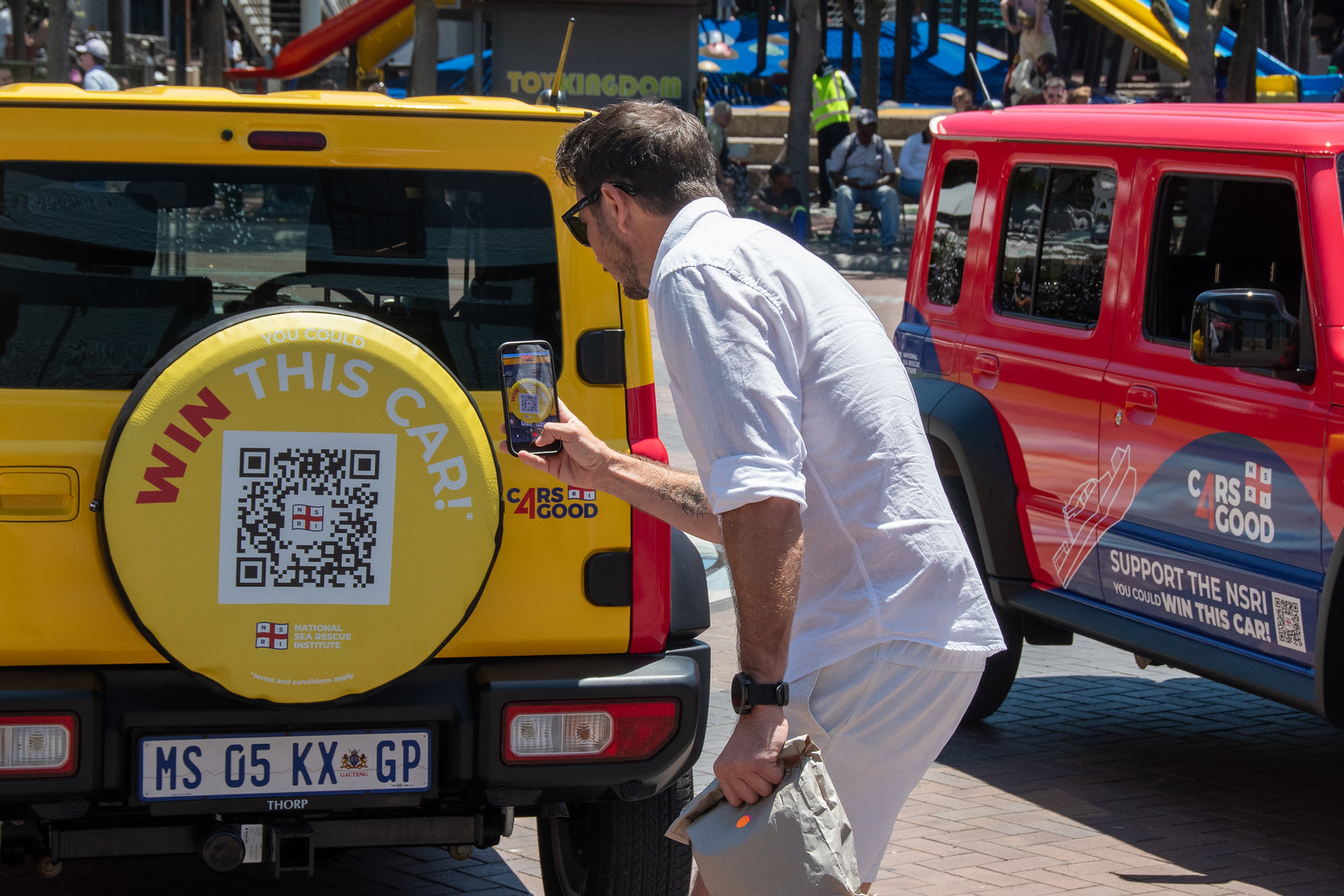
Each Jimny is fitted with a QR code that links directly to the campaign. Whether spotted at the beach or in a city parking lot, the message is clear: every ticket sold helps save lives.
Cars4Good 2026 tickets cost R695, with only 45,000 available. Each ticket enters the NSRI supporter into four draws throughout the year, offering a chance to win one of four Suzuki Jimny 5-doors (each valued at R465,900).
Funds raised will support the NSRI’s core rescue and prevention services, including:
Water Safety Education: Over 900,000 lessons delivered in 2025 to children in high-risk communities
Survival Swimming: More than 25,000 children trained to float, orient and move through water
Training & Rescue Equipment: For the NSRI’s 1,500-strong volunteer crew.
“We are grateful to the National Lotteries Commission for their guidance and oversight, which ensures that the Cars4Good fundraising campaign is conducted with integrity, fairness, and transparency,” says Alison Young, NSRI’s Head of Performance Marketing. “Their support helps maintain public trust - something we deeply value.”
“As Suzuki Auto South Africa, we are thrilled to be a partner of the well-known and trusted National Sea Rescue Institute. As a vehicle partner, we are committed not only to supporting the Cars4Good competition but also to engaging in many projects and activations where Suzuki products and our audience can make a tangible difference to life-saving efforts,” says Brendon Carpenter, Brand Marketing Manager at Suzuki Auto South Africa.
“This is more than a fundraising drive,” says Mike Vonk, NSRI CEO.
“It’s a campaign that represents who we are: practical, accountable, and deeply committed to saving lives.
Every ticket sold helps put a trained rescuer on the water, a safety educator in a classroom, or a survival swimming instructor in a pool - because behind every rescue is a family waiting for someone to come home.”
For campaign info and to enter Cars4Good 2026 click here
Between 15 December 2025 and 15 January 2026, NSRI volunteers rescued 201 people - a 26% increase from the same period last year. National callouts rose by 32.5%, while the most alarming statistic was a 117% surge in “Drowning in Progress” incidents, where lives hung in the balance and required an immediate response. These emergencies jumped from 18 to 39 from the previous festive season.
Cars4Good 2026 aims to turn this crisis into a call for action - while shining a light on a devastating reality: more than 1,000 people drown each year in South Africa, many of them children.
Four Jimnys. Four missions. One cause.
At the heart of the campaign is a unique partnership with Suzuki Auto South Africa. Four specially wrapped Suzuki Jimnys are now touring the country, each one bringing to life a different NSRI pillar:
*Blue – Showcases NSRI’s whale disentanglement units, which rescued 70 marine animals in 2025 alone.
*Red – Represents 1,069 rescue operations in 2025, saving 1,548 lives, often in treacherous conditions.
*Yellow – Celebrates the NSRI lifeguards at 55 beaches, who prevent emergencies before they happen.
*Pink – Tells the story of the Pink Rescue Buoy project, credited with saving over 251 lives since its launch in 2017.
“These Jimnys are fun, eye-catching, and different – just like the NSRI’s approach to turning everyday South Africans into life-savers,” says Dirk Coetzee, NSRI Business Development Manager. “Suzuki doesn’t partner lightly, and neither do we. This collaboration is about real impact, built on trust and shared purpose.”
Each Jimny is fitted with a QR code that links directly to the campaign. Whether spotted at the beach or in a city parking lot, the message is clear: every ticket sold helps save lives.
Cars4Good 2026 tickets cost R695, with only 45,000 available. Each ticket enters the NSRI supporter into four draws throughout the year, offering a chance to win one of four Suzuki Jimny 5-doors (each valued at R465,900).
Funds raised will support the NSRI’s core rescue and prevention services, including:
Water Safety Education: Over 900,000 lessons delivered in 2025 to children in high-risk communities
Survival Swimming: More than 25,000 children trained to float, orient and move through water
Training & Rescue Equipment: For the NSRI’s 1,500-strong volunteer crew.
“We are grateful to the National Lotteries Commission for their guidance and oversight, which ensures that the Cars4Good fundraising campaign is conducted with integrity, fairness, and transparency,” says Alison Young, NSRI’s Head of Performance Marketing. “Their support helps maintain public trust - something we deeply value.”
“As Suzuki Auto South Africa, we are thrilled to be a partner of the well-known and trusted National Sea Rescue Institute. As a vehicle partner, we are committed not only to supporting the Cars4Good competition but also to engaging in many projects and activations where Suzuki products and our audience can make a tangible difference to life-saving efforts,” says Brendon Carpenter, Brand Marketing Manager at Suzuki Auto South Africa.
“This is more than a fundraising drive,” says Mike Vonk, NSRI CEO.
“It’s a campaign that represents who we are: practical, accountable, and deeply committed to saving lives.
Every ticket sold helps put a trained rescuer on the water, a safety educator in a classroom, or a survival swimming instructor in a pool - because behind every rescue is a family waiting for someone to come home.”
For campaign info and to enter Cars4Good 2026 click here