Relief for consumers as fuel prices decrease

Petrol and diesel prices will drop between 50c and 65c from this Wednesday, the Department of Mineral and Petroleum Resources (DMPR) has announced.

Paraffin will also decrease, while LP Gas consumers will see increases.

The following price adjustments will apply from Wednesday:
-Petrol 93 (ULP and LRP): 65c decrease.
-Petrol 95 (ULP and LRP): 65c decrease.
-Diesel (0.05% sulphur): 50c decrease.
-Diesel (0.005% sulphur): 57c decrease.
-Illuminating Paraffin (wholesale): 53c decrease.
-Single Maximum National Retail Price for Illuminating Paraffin: 70c decrease.
-Maximum Retail Price of LP Gas: 31c increase (with a 36c increase in the Western Cape).

“The average international product prices decreased due to availability of inventories, despite increase in crude oil prices. These factors led to lower contributions to the Basic Fuel Prices of petrol, diesel and illuminating paraffin by 36c/l [cents per litre], 24.59 c/l and 21.13 c/l respectively.

“The prices of Propane and Butane increased during the period under review due to the cold weather in the Northern Hemisphere and tighter global supply,” the DMPR said.

The Rand also strengthened against the US Dollar (USD), gaining ground from R16.85 to 16.31 Rand per USD during the period under review.

“This led to lower contributions to the Basic Fuel Prices of petrol, diesel and Illuminating Paraffin by 28.52 c/l, 31.62 c/l and 31.86 c/l respectively,” the department explained. 

260 days of No Loadshedding as Eskom progress continues

Eskom’s recovery continues to yield results as the power utility records some 260 days without the implementation of load shedding.

The sustained progress stems from implementation of the Generation Recovery Plan, government’s Energy Action Plan and the improvement in the Energy Availability Factor (EAF).

“Together, these developments are enhancing operational reliability and supporting South Africa’s long-term energy security,” Eskom said in a statement.

According to the electricity provider, the EAF increased to 64.95% between 1 April 2025 to 29 January 2026, underscoring the “progress made in restoring reliability and enhancing system stability."

“The fleet has now achieved or exceeded the 70% EAF mark on 64 occasions [un-audited figures].

“The improvements in EAF demonstrate both recovery and sustained improvement in EAF performance, reinforcing energy security, grid stability and security of the national electricity supply,” Eskom added.

Unplanned outages have also shown improvement and have decreased from 12 993MW during the period between 23 January and 29 January last year to some 8 362MW during the same period this year – an improvement of 4 630MW.

“Over the same period, the Unplanned Capacity Loss Factor [UCLF] reduced to 17.27%, a significant improvement of 9.90% compared to 27.17% recorded during the same period last year.

“During the same period, Eskom’s Planned Capacity Loss Factor [PCLF] – essentially planned maintenance – averaged 10.46%, compared to 15.82% in the previous financial year.

“This reduction is consistent with Eskom’s maintenance schedule and reflects our strategy to enhance plant reliability, strengthen operational stability and support long-term fleet performance,” the power utility said.
Improvements in the EAF have allowed Eskom to decrease reliance on diesel generation with expenditure on the costly fuel remaining below budget in the year to date.

“After five consecutive weeks with no diesel expenditure for Open-Cycle Gas Turbines [OCGT] operations, diesel spend of R1.61 million was recorded [last] week, with 0.285GWh of associated energy send-out.

“Despite this, the total diesel expenditure remains R4.26 billion lower than at the same point last year. This sustained reduction reflects both significant cost savings and ongoing improvements in operational performance driven by Eskom’s turnaround initiatives. Overall, the trend underscores the increasing stability, efficiency and resilience of the power system,” Eskom noted.

Some 2 200MW of generation capacity is expected to be brought online this week.

SA at ‘no immediate risk’ of Nepah virus – Health Department

South Africa is currently under “no immediate risk” of the Nipah Virus (NiV) outbreak reported in India.

This is according to the Department of Health (DoH) which assured in a statement that there is “no need for the public to panic.”

Two cases of the potentially fatal virus were reported by Indian authorities in January 2026.

“The department is working closely with the National Institute for Communicable Diseases [NICD] which is closely monitoring the situation as the outbreak evolves and will keep the public informed of any new developments. 

“The scientists have advised that at this stage there is a very low risk outside the affected countries and there is no need for screening at ports of entry. Meanwhile, the NICD will be offering training to the Civil Aviation Authority as part of efforts to assist in communicating the message through the airlines and airport staff,” the statement read.

The department explained that the virus jumps from animals to humans, usually “transmitted from animals like bats to humans”.

However, it can also be transmitted from contaminated food or directly between people.

“The virus is currently not categorised under notifiable medical conditions but will be categorised as a respiratory disease of unknown origin which is notifiable. Laboratory testing is available at the NICD, and key resources have been updated to include current outbreak specifics.

“Transmission of this deadly virus to humans can occur from direct contact with infected animals like bats, farming animals such as pigs or horses and by consuming fruits or fruit products, such as raw date palm juice, contaminated by infected fruit bats. Some of the symptoms of Nipah virus include fever, headache, difficulty breathing or cough.

“According to the World Health Organisation, there is currently no treatment or vaccine available for this virus, however several candidate products are under development. Early intensive supportive care can improve survival. This means non-pharmaceutical interventions such as hygiene practices remain one of the most effective prevention methods to reduce the spread of the virus,” the department added.

Animal-to-human transmission risk can be reduced by “wearing gloves and other protective clothing while handling sick animals such as pigs or horses, and during slaughtering and culling procedures.”

Austrian man drowns at Wilderness beach

An Austrian tourist has died following a drowning incident at Leentjiesklip Beach in Wilderness on Saturday afternoon.

NSRI Wilderness was activated at around 3pm after reports of swimmers in distress. George Municipal lifeguards responded to three swimmers caught in rip currents - two men and a woman.

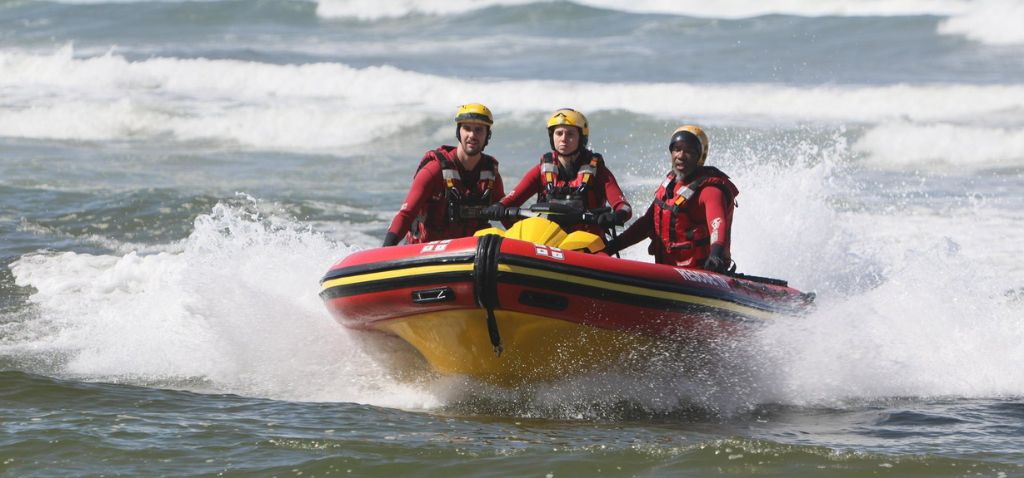
Rescue swimmers, additional lifeguards, EMS, George Fire and Rescue, law enforcement and police were dispatched to the scene. The NSRI rescue craft JetRIB Ann Stratford was launched.

A 19-year-old woman and her 21-year-old male friend, a university student from Cape Town, were rescued from the water and were not injured.

A 49-year-old Austrian man was also pulled from the surf with the assistance of lifeguards, rescue swimmers and bystanders. CPR was performed on the beach before paramedics arrived. He was transported to hospital in a critical condition after a faint pulse was restored.

Despite extensive resuscitation efforts, the man was declared dead later that night.

Police have opened an inquest docket. The incident is believed to have occurred near the peak of the spring high tide, when the swimmers were caught in strong rip currents.

The NSRI has extended condolences to the deceased’s family and friends. Support is being provided by the NSRI, the Austrian Consulate, Southern Cape Tourism Assist and police.

error: eRadio is protected !
Scroll to Top