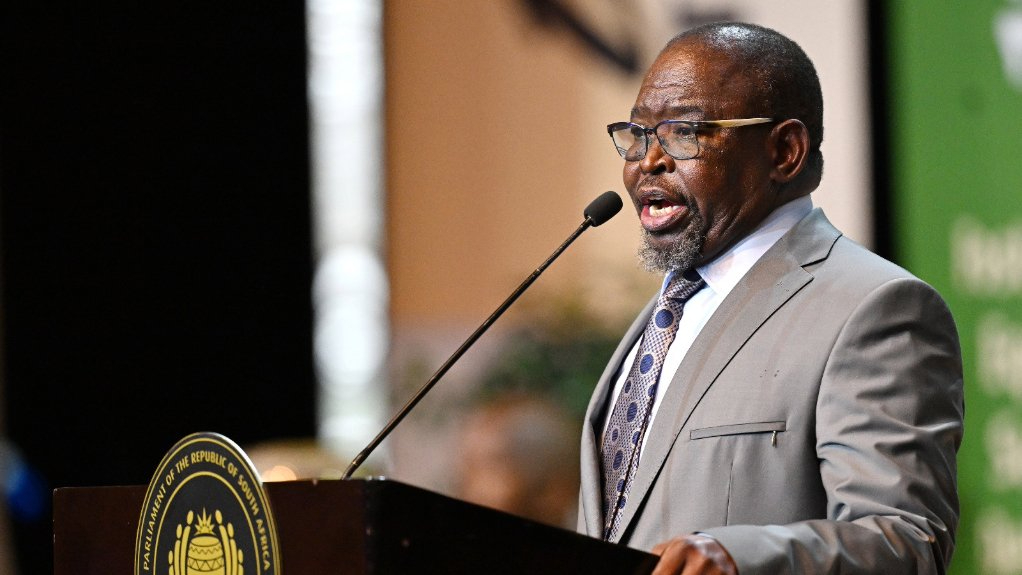
Honourable Speaker, Thoko Didiza
Deputy Speaker, Annelie Lotriet
His Excellency, President Cyril Ramaphosa
Honourable Deputy President Paul Mashatile
Cabinet Colleagues
The Budget Council
The Budget Forum
Governor of the South African Reserve Bank, Lesetja Kganyago
Commissioner of the South African Revenue Service, Edward Kieswetter
Chairperson of the Financial and Fiscal Commission, Patience Mbava
Honourable Members
Fellow South Africans
I have the honour to table the following documents before this House:
The 2026 Division of Revenue Bill
The 2026 Appropriation Bill
The 2025/26 Special Appropriation Bill
The 2026 Estimates of National Expenditure
The 2026 Budget Review
The 2026 Budget Speech
Introduction
Honourable Members, we have reached an important turning point in the management of our public finances.
Five years ago, the outlook was stark.
State Capture had hollowed out critical institutions and weakened state owned entities.
South Africa had been downgraded to junk status by the last of the three major credit rating agencies in 2020.
The devastation of the coronavirus pandemic coupled with the Russia-Ukraine conflict had dealt a blow to global growth.
And in 2023, the Financial Action Task Force had placed South Africa on its grey list.
The warning lights were flashing.
Public finances were under severe strain and growth had stalled.
Faced with this crisis, we chose not to be defined by it. Instead, we turned it into a catalyst for change.
We committed to a clear reform agenda and a disciplined fiscal strategy built on three principles: stabilise debt, invest in infrastructure and spend better.
Today, that commitment has delivered tangible results.
For the first time in 17 years, debt will stabilise and it will continue to fall in the coming years.
The budget deficit has narrowed significantly, and debt-service costs are also falling.
The world has taken notice:
South Africa has been removed from the FATF grey list;
We secured our first credit rating upgrade in 16 years;
And borrowing costs have eased, creating space for growth and development.
These are signals of restored credibility. Of renewed resilience. And of a nation regaining its footing.
The lesson is a simple but powerful one: steady structural reform and responsible public finances are the bedrock of a prosperous and more inclusive South Africa.
Economic Outlook
Honourable Members, allow me to turn to the global and domestic economic outlook.
Global outlook
The global economy is projected to grow by 3.3 per cent in 2026, broadly in line with last year’s outcome.
Advanced economies are expected to grow moderately, while emerging markets will continue to anchor global momentum. India and Sub-Saharan Africa in particular, are forecast to grow more strongly, supported by resilient domestic demand.
These developments are unfolding within an unprecedented global trade environment characterised by persistent geopolitical tensions and shifting trade policies which are reshaping supply chains.
In response we need to diversify our trading portfolios, secure new markets, reduce vulnerability to external shocks and position ourselves to benefit from emerging global growth centers.
Domestic outlook
On the domestic front, our growth outlook is steadily improving.
We project real economic growth of 1.6 per cent in 2026, an improvement from the 1.4 per cent estimated in 2025.
This improvement reflects the continued strengthening of economic performance from the second half of 2025.
Over the medium term, growth is expected to average 1.8 per cent, reaching 2 per cent by 2028.
Persistent logistics bottlenecks, weak public infrastructure and the recent outbreak of foot-and-mouth disease continue to weigh on economic activity and pose risks to the outlook.
In light of this, rapid inclusive growth remains our only durable path forward.
Our efforts to promote faster economic growth continue to revolve around the four pillars:
Maintain macroeconomic stability,
Implement structural reforms,
Invest in growth-enhancing infrastructure, and
Build state capacity
These pillars are the foundation upon which inclusivity is built, and how we ensure that growth is faster.
Fiscal Strategy
Madam Speaker, a key facet of macroeconomic stability is prudent fiscal management that advances socioeconomic obligations.
Our fiscal strategy involves four key features:
Support economic growth by accelerating public investment.
Improve the efficiency of public spending.
Improve the composition of spending by containing the public-service wage bill while increasing capital investment.
Entrench sustainable public finances with a principles-led fiscal anchor.
We are already reaping the fruits of this strategy.
The consolidated budget deficit has narrowed to 4.5 per cent of GDP for 2025/26, an improvement from 4.8 per cent that we estimated in the 2025 Budget. The deficit falls to 4 per cent in 2026/27 and 3.1 per cent the year after.
Gross debt stabilises as a share of GDP in 2025/26, at 78.9 per cent. In 2026/27 it falls further, to 77.3 per cent of GDP and declines to 76.5 per cent by 2028/29.
The slightly higher debt peak this year reflects weaker nominal GDP growth and our decision to take advantage of strong investor demand in domestic and global markets by increasing issuance in 2025/26.
The main budget primary surplus for 2025/26 reaches 0.9 per cent of GDP.
In the next financial year it expands to 1.6 per cent, and then to 1.9 per cent in 2027/28. By 2028/29, we see it reaching 2.3 per cent.
Honourable Speaker, to sustain fiscal discipline, we intend to continue the engagements on fiscal anchors.
We aim to introduce a proposal for a principle-based fiscal anchor in the Medium-Term Budget Policy Statement after thorough consultation in Cabinet, Parliament and with the public.
Just as inflation targeting provided clarity and credibility to monetary policy, the fiscal anchor aims to entrench fiscal credibility.
Implementing Structural Reforms
Madam Speaker, the structural reforms to lift growth we are implementing alongside this fiscal strategy reflect an understanding that the state should adjust to the needs of the national economy in a flexible way. Operation Vulindela must be understood in this context.
In terms of energy reforms, we are stabilising electricity supply and building a competitive, reliable energy market.
Regulatory reforms in this sector have unlocked significant private investment, accelerating generation capacity and driving the transition towards cleaner, renewable power.
In logistics, we are dismantling bottlenecks in rail and ports that have throttled exports and raised the cost of doing business.
Our intention is to bolster public-private investment in rail operations while retaining state ownership of rail infrastructure.
The objective is to move goods faster, cheaper and more reliably.
Reforms in local government include shifting to a performance-linked utility model for water and electricity services.
This is aimed at strengthening financial sustainability, accountability and transparency.
Spatial and housing reforms focus on restructuring our cities to ensure that people have access to affordable housing located close to centers of economic activity.
This is a systematic effort to remove the structural blockages that have held back growth for many years.
Revenue trends and outlook
Madam Speaker, over the past three years, our tax system has demonstrated resilience despite slow economic growth.
For 2025/26, the gross tax revenue is revised up by R21.3 billion compared to the estimate in the 2025 Budget.
Higher-than-expected net VAT, corporate income tax and dividends tax collections, improved the in-year outlook.
As a result, government has decided to withdraw the R20 billion in tax increases provisionally included in the May 2025 Budget.
The improving fiscal position allows us enough room to withdraw the proposed tax increases, without putting fiscal sustainability or economic activity at risk.
We are also proposing additional tax measures to ease the financial burden on households and businesses, by adjusting personal income tax brackets and rebates fully in line with inflation.
Madam Speaker, our national savings and investment rate is far below the levels needed to truly create generational wealth and support local investment in the economy.
To encourage South Africans to save more, we propose that:
The tax-free annual investment limit be increased from R36 000 to R46 000 per year.
The limit to retirement fund deductions be raised from R350 000 to R430 000, allowing individuals to invest more each year on a tax-free basis.
Madam Speaker each year we ask South Africans to send in their “Tips for the Budget”. This year more than 1,200 citizens sent us their opinions and suggestions.
Renette Oosthuizen, a small business owner from Gauteng, had this tip:
“Minister Godongwana, please increase the VAT registration threshold for small businesses to R2 million. The R1 million threshold has not kept pace with the cost of doing business.”
Renette, you will be happy to know that in this budget the compulsory VAT registration threshold increases from R1 million to R2.3 million.
We are taking other measures to support small businesses:
We are raising the capital gains tax exemption for the sale of a small business for older persons from R1.8 million to R2.7 million. This applies to small businesses worth R15 million instead of the R10 million previously. It will enable small business owners to receive more tax relief when they sell their businesses.
Madam Speaker, increases to certain taxes are unavoidable.
For 2026/27, excise duties on tobacco will be increased in line with inflation.
This includes excise duty on electronic nicotine and non-nicotine delivery systems.
As a result:
The tax on a 20-pack of cigarettes rises from R22.81 to R23.58.
Pipe tobacco rises by 28 cents per 25 grams, and cigarette tobacco by 87 cents per 50 grams.
Cigars rise by R4.56 per 23 grams.
The excise on alcoholic beverages also rises by inflation.
As such:
A 340 millilitre can of beer or cider increases by 8 cents.
A 750 millilitre bottle of wine goes up by 15 cents.
A 750 millilitre bottle of spirits will increase by R3.20.
In terms of fuel levies, the total increase will also be in line with inflation.
The general fuel levy will go up by 9 cents per litre for petrol and 8 cents per litre for diesel.
The carbon fuel levy will go up by 5 cents per litre for petrol and 6 cents for diesel.
The Road Accident Fund levy will increase by 7 cents per litre.
Honourable Members, the strong revenue collection this year, and the overall resilience of tax administration, reflects an efficient and agile tax administration, continually improving through targeted compliance initiatives.
However, the scourge of illicit trade represents a major threat to these hard-won gains. It threatens our economy, endangers consumers, and robs the fiscus of billions in revenue.
The recent announcement by a major tobacco producer, that will close its local operations, is a stark reminder of the impact of illicit trade on jobs and the overall economy.
The sophisticated and organised nature of illicit operations demands an intensified effort to curb this trade, secure prosecutions and dismantle its supply chains.
SARS has already intensified its efforts. It will also continue its joint operations with the Border Management Agency, the SAPS and the defence force to stop the illicit trade in tobacco.
Financial Sector Reforms
Madam Speaker, National Treasury continues to work on ensuring that financial services customers are treated fairly and the sector operates optimally.
One key issue is the more than R88 billion of unclaimed financial assets and benefits.
Following recommendations from the Financial Sector Conduct Authority, National Treasury will introduce reforms to manage these unclaimed benefits through the creation of a central administrator responsible for record keeping and tracing.
Crypto Assets
We will also shortly publish draft regulations under the Currency and Exchanges Act, to include crypto assets in our capital flow management regime.
Crypto assets will now be governed in the cross-border movement of capital framework, which will be complementary to regulations already in place to prevent the use of crypto assets to launder money and commit fraud.
Data infrastructure
The use of data and artificial intelligence has become critical for the future development of economies worldwide. As such data infrastructure should be considered as critical as electricity, ports and transport networks.
This year we will be exploring options to help data centres and related infrastructure to expand these investments in South Africa and solidify our role as a regional hub for these technologies.
Trade
One of the main policy objectives is to ensure that the financial sector supports regional integration and the implementation of the Africa Continental Free Trade Agreement.
National Treasury is easing restrictions on the cross-border flows of capital by enabling domestic asset managers to manage portfolios of foreign assets.
This will improve competitiveness and allow South Africa to function as a hub for investment into the continent.
Payments
National Treasury, working with the South African Reserve Bank, has prioritised modernising the national payments system and innovation in digital finance.
The Payments Ecosystem Modernisation (PEM) has achieved its first key milestone with the establishment of a Payments Utility, which was completed in November last year with the establishment of PayInc.
PayInc will provide open, shared digital payments infrastructure to support operability across various payment providers, serving as the main platform for high-value and retail transactions.
Targeted and responsible savings
Madam Speaker, in the Budget last May we promised that spending priorities would not be funded through tax increases if this could be avoided.
We have kept that promise, through our commitment to finding savings from unproductive expenditure, closing leakages, and rooting out inefficiencies.
I am happy to announce that R12 billion in savings have been identified over the medium term.
Targeted and responsible savings are not a once-off initiative.
They will be an ongoing and entrenched part of the budget process going forward to weed out inefficiencies and low-performing programmes.
Every programme and every allocation must demonstrate value, efficiency and accountability.
As part of this process, the Public Transport Network Grant has been scaled down, by about R8.4 billion, over the next three years.
The grant has not improved access to public transport relative to the investments made.
The grant will, however, continue to help cover indirect costs in cities that run bus services.
Enhanced targeting of social grants authentication of beneficiaries to reduce fraud in the grant system will yield R3 billion of savings.
The South African Social Security Agency has upgraded its biometric and income verification processes, resulting in nearly 35 000 grants being identified as incorrect or fraudulent, and therefore terminated.
Honourable Members, we are committed to improving access for the many South Africans deserving and eligible for social support.
Abuse of the system will not be tolerated.
The remaining savings from TARS are reallocated to strengthen capacity in the judiciary, border management, defence and Stats SA.
Madam Speaker, to secure the skills essential to a modern economy, government is reforming the national skills ecosystem.
The skills development levy paid by employers to fund Sector Education and Training Authorities, or SETAs, and the National Skills Fund, have not yielded the outcomes we expected.
We must improve how we equip individuals ready to enter the labour market.
Beyond providing them a theoretical understanding, the government will explore ways to reorganise training by introducing a dual-training skills acquisition system.
We are also looking at how institutions with the capacity to train job-seekers and graduates can tool them with artisanal skills.
Spending Priorities
Madam Speaker, in 2026/27, we will spend R2.67 trillion.
This spending includes a proposed R5 billion in the contingency reserve to cater to disasters declared since the MTBPS.
Government spending remains highly redistributive. The social wage accounts for more than 60 per cent of non-interest spending over the medium term.
Basic education, health and social protection constitute 70.3 per cent of the social wage in 2026/27, providing support to 13.6 million school children, healthcare services to 84 per cent of the population and social grants to 26.5 million beneficiaries.
Social grants
For 2026/27, social grants are allocated R292.8 billion, enabling the following increases:
The old age grant, disability grant and care dependency grant rise by R80 in April 2026, to R2 400.
The war veterans grant also increases by R80 to R2 420.
The foster care grant goes up to R1 290 in April, a R40 increase and to R1 300 in October, a R10 increase.
The child support grant and grant-in-aid grant increase by R20 to R580.
The social relief of distress continues in its current form over the year ahead.
Peace and security
Madam Speaker, the President in his State of the Nation Address announced the deployment of the defence force alongside police to fight illegal mining and gangsterism.
To support this and other efforts to intensify law and order, spending on peace and security increases from R268.2 billion in 2025/26 to R291.2 billion in 2028/29.
The Border Management Authority has been allocated an additional R990 million over the medium term to build capacity by filling 738 positions.
R2.7 billion is added to defence over the medium term to improve operations, including to maintain the South African Air Force’s fighter capability.
In addition we have allocated R1 billion to the police service, and another R1 billion to the SANDF, through the CARA fund for the fight against organised crime.
Over the medium term, R883.8 million is shifted from the Department of Justice and Constitutional Development to the Office of the Chief Justice.
This will enable the Office of the Chief Justice to manage its own budgets, enhancing its independence from the Executive from the first of April.
Similar arrangements for the funding of Parliament are being undertaken, in the spirit of separation of powers.
An additional R687 million has been allocated to increase capacity in the judiciary.
The President also announced the establishment of specialised courts. Once the costing is finalised, allocation for this will be considered later in the year.
For the various commissions of inquiry underway that are unlikely to finish within their initial deadlines, funding will also be made available when the costs become clearer.
Special appropriation
Madam Speaker, the fiscal framework tabled in the 2025 MTBPS included R8.5 billion that we added to the contingency reserve.
The special appropriation bill tabled today allocates these funds.
The special appropriation bill also includes, amongst others:
R5.8 billion for PRASA’s rolling stock fleet renewal programme;
R1 billion for South Africa’s share subscription to the international finance corporation; and
R700 million for the Department of Communications and Digital Technology.
Division of revenue
Madam Speaker, in 2026/27, 48.9 per cent of nationally raised revenue is allocated to national government, 41.7 per cent to provinces and 9.4 per cent to local government.
The split translates to R951,7 billion for national government, R810.5 billion for provinces and R182,3 billion for municipalities.
Additional allocations to the provincial equitable share include R342 million to progressively equalise Grade R teacher pay, R340 million for the early retirement and voluntary exit programme, and R319 million for the presidential employment initiative.
R1.5 billion is added to the provincial roads maintenance grant in 2026/27 to fund the carry-through costs of the disasters that occurred between April 2024 and June 2025.
Basic Education
In terms of consolidated expenditure, spending on education remains the largest component at 23.7 per cent over the medium term.
Basic education receives R22.7 billion for carry-through costs announced in May 2025. Early childhood development receives the majority of these funds.
R9.9 billion supports employee compensation and other pressures in education.
Early childhood development grant receives an additional R12.8 billion over the next three years, expanding service to an additional 300 000 children.
This will also maintain the increased per child, per-day subsidy of R24 introduced in 2025/26.
The increased allocations align the National School Nutrition Programme to food inflation to continue providing meals to over 9.9 million learners in almost 20 000 schools.
Health
Madam Speaker, R26 billion is allocated to provinces to bolster our HIV/AIDS programme such as the prevention of mother-to-child transmission and the provision of anti-retro virals.
As part of the targeted and responsible savings initiative, provinces will repurpose some of their funding to meet obligations towards PEPFAR. This follows the funding withdrawal by the United States.
R21.3 billion is allocated to the health sector over the medium term for the compensation and employment of doctors, and to make up for shortfalls in goods and services expenditure.
Local Government
Madam Speaker, of the allocated funding to local government, R86.9 billion is to support the provision of free basic services to 11.2 million households.
Local government is the sphere where communities experience the state most directly. Yet many municipalities are in financial and operational distress and therefore unable to deliver services as they should.
Audit outcomes highlight this unacceptable reality: 63 per cent of municipalities are in financial distress, and the proportion of clean audits remains unacceptably low.
A central challenge with municipalities is that they not only differ in capacity, but also in their revenue-raising potential.
This demands a more targeted approach to respond to the diverse pressures facing municipalities.
The National Treasury is revitalising support for development of long-term financial plans.
These plans will improve project identification, sustainably plan cash flows and inform financial decisions. This will negate the challenge of unfunded mandates and limited capacity to maintain infrastructure and sustain services.
Further structural reforms are underway including a comprehensive review of the local government fiscal framework.
Together, these reforms will modernise the intergovernmental system and build a more capable, resilient and appropriately differentiated local government sphere.
Metro Trading Services
Honourable Members, municipalities must return to the foundational principle of fiscal integrity.
Revenue collected for a specified function must first sustain that function before any cross-subsidisation can occur.
In reality, this principle is consistently flouted.
For instance, Johannesburg’s water revenue is R11.9 billion but only R1.3 billion is allocated to Joburg Water for capital expenditure.
This has contributed to the massive backlog of R64 billion that is needed to fix water supply problems in the city.
If this practice of collecting revenue from basic services while diverting the funds to unrelated functions continues, maintenance backlogs will grow, services deteriorate and critical infrastructure systems eventually collapse.
To correct the trajectory, R27.7 billion has been allocated over the medium term to a performance-linked reform for metro trading services in electricity, water, sanitation and solid waste.
This is the first step towards matching revenue collection to reinvestment in the same service.
The reform however goes beyond the performance-based grant structure.
It entrenches operational and financial management reform.
Under the new system, failure to meet reform and operational targets will result in budgets being reduced.
This will strengthen accountability and governance, enabling long-term infrastructure investment.
And supporting the sustainable turnaround of these essential services.
Qualifying municipalities, including eThekwini and City of Johannesburg, have begun implementing Council-approved improvement plans to ring-fence revenue and reinvest in water and electricity.
Municipal Infrastructure Grant Reform
Government is also reforming the municipal infrastructure grant to address persistent underspending, misuse of funds and capacity constraints that hinder effective service delivery in non-metropolitan municipalities.
A split delivery model has been introduced. Municipalities with proven capacity will continue to receive funding directly.
However, where there are serious capacity or governance failures, the delivery will shift to an indirect model.
Capable district municipalities and other accredited implementing agencies will form part of their infrastructure delivery suite.
The intention is to protect citizens from persistent municipal dysfunctions that have long undermined effective service delivery.
Infrastructure
Madam Speaker, infrastructure investment remains the foundation upon which long-term economic growth, improved service delivery and job creation are built.
Government is shifting the composition of spending towards growth-enhancing public infrastructure.
Over the medium-term, public-sector spending on infrastructure will exceed R1 trillion.
Of this:
R577.4 billion will be spent by state owned companies and other public entities;
R217.8 billion by provinces; and
R205.7 billion by municipalities.
By sector, transport and logistics make up the largest share.
Transport, Water and Energy
SANRAL will focus on strengthening long-term network resilience. This includes the annual maintenance of approximately 27,000 kilometers and the resurfacing of 2,000 kilometers of road.
The Passenger Rail Agency of South Africa (PRASA) will continue implementing its corridors recovery programme and modernising core infrastructure to rebuild a reliable, affordable rail service for commuters.
This will enable the increase in annual passenger trips from 77 million in 2024/25 to between 250 and 450 million over the medium term.
In energy, investment will focus on improving security of supply and mobilise private investment.
Since the MTBPS, I am pleased to announce that National Treasury together with the World Bank are making significant progress with the Credit Guarantee Vehicle.
The CGV, which will support massive investments in transmission infrastructure, will be incorporated as a company in the coming months. Next, we expect development partners to confirm their capital participation.
Thereafter, the CGV will apply for a license from the Prudential Authority. We are targeting the CGV to be operational later this year.
In water, investments are directed towards high-impact bulk water augmentation schemes, refurbishment of ageing infrastructure and the completion of strategic projects that support economic nodes, agriculture and household supply.
Honourable Members, we continue to implement reforms to unlock greater private sector participation, enhance spending efficiency and shorten delivery timelines.
Public-Private Partnerships
The amendment of the PPP regulations has enabled greater private sector participation by streamlining procedural requirements, closing regulatory gaps and clarifying institutional roles.
The pipeline is projects is growing. Currently, 63 projects are at different stages of development.
Among the most advanced are the six border posts project which will ease congestion, lift regional trade flows and upgrade key inland border posts.
We expect them to reach financial closure later this year.
Similarly, the process of procuring a new vendor for the Gautrain rapid rail link system is advanced.
Conclusion of these projects will mark the first closure of major PPP transactions in more than five years.
Public institutions should increasingly see PPPs as a viable alternative method for delivery, particularly in cases where funding limitations or capacity constraints hinder effective implementation.
To further unlock PPP opportunities across government, work is underway to finalise the new PPP regulations for municipalities.
The final regulations will be published by 30 June 2026.
Budget Facility for Infrastructure
The budget facility for infrastructure continues to play a pivotal role in enabling funding of strategic infrastructure projects.
Since shifting from annual to quarterly windows last year, the BFI has approved R21.9 billion for five major projects.
These include Transnet’s coal and iron ore corridor projects, which will restore rail capacity to 77 million tonnes for the coal line and 60 million tonnes for the ore line, and the Polokwane regional wastewater programme.
As part of the efforts to position infrastructure as an investable asset class, government issued an infrastructure bond in 2025 raising R11.8 billion to support its contribution in BFI approved projects.
The BFI call for proposals for the 2026/27 cycle opens today. The detailed circular has been published on the National Treasury website.
We call on public institutions in key sectors of the economy to submit proposals with funding gaps and strategic value, for consideration.
This includes critical social infrastructure such as courts, correctional facilities, police stations and even the development of new tertiary institutions like the proposed Ekurhuleni University and student accommodation, as well as health care facilities such as the Dr George Mukhari Academic and the Inkosi Albert Luthuli Hospital.
Conclusion
Madam Speaker, the progressive realisation of the fundamental socioeconomic rights enshrined in our constitution is essential to our mission to deal with inequality, poverty and unemployment.
It is a mission that demands that we make prudent fiscal choices.
With the health of our public finances comes a greater degree of economic freedom and sovereignty.
It is this sovereignty that gradually frees us from over-reliance on external debt.
It shields us from the inherent uncertainties of global finance and global politics.
As we have witnessed over the last few years, the established norms of the global order can shift and be undermined.
To achieve our ultimate goal of bettering the lives of our people we must continue pursuing this sovereignty.
A budget and a fiscal strategy that advances inclusive growth and the sustainability of public finances is a crucial part of achieving this greater freedom.
It moves us closer to fulfilling our constitutional promise to do all that it takes for our people to live with dignity and prosperity.
Madam Speaker, I am grateful to the President and Deputy President for their support and leadership.
Thank you to the Deputy Ministers of Finance, and the excellent National Treasury team, led by the Director-General.
My sincere thanks to the Governor of the South African Reserve Bank.
Let me also thank my colleagues in the Ministers’ Committee on the Budget and in the Budget Council who have shared the task of difficult trade-offs that have to be made.
Similarly, to the Parliamentary Committees of Finance and Appropriations, I express my sincere appreciation.
To my wife and family, it is your encouragement and sacrifice that makes this work possible. Thank you.
Madam Speaker, as Commissioner Kieswetter prepares to take his leave at the end of April, I ask this House to join me in thanking him for seven years of patriotic, dedicated service.
Commissioner, your unwavering integrity and commitment to operational excellence is an example to all of us.
Lastly, I thank every South African. This Budget reflects our shared journey and the belief that together we can build a more equal, more prosperous economy.
Deputy Speaker, Annelie Lotriet
His Excellency, President Cyril Ramaphosa
Honourable Deputy President Paul Mashatile
Cabinet Colleagues
The Budget Council
The Budget Forum
Governor of the South African Reserve Bank, Lesetja Kganyago
Commissioner of the South African Revenue Service, Edward Kieswetter
Chairperson of the Financial and Fiscal Commission, Patience Mbava
Honourable Members
Fellow South Africans
I have the honour to table the following documents before this House:
The 2026 Division of Revenue Bill
The 2026 Appropriation Bill
The 2025/26 Special Appropriation Bill
The 2026 Estimates of National Expenditure
The 2026 Budget Review
The 2026 Budget Speech
Introduction
Honourable Members, we have reached an important turning point in the management of our public finances.
Five years ago, the outlook was stark.
State Capture had hollowed out critical institutions and weakened state owned entities.
South Africa had been downgraded to junk status by the last of the three major credit rating agencies in 2020.
The devastation of the coronavirus pandemic coupled with the Russia-Ukraine conflict had dealt a blow to global growth.
And in 2023, the Financial Action Task Force had placed South Africa on its grey list.
The warning lights were flashing.
Public finances were under severe strain and growth had stalled.
Faced with this crisis, we chose not to be defined by it. Instead, we turned it into a catalyst for change.
We committed to a clear reform agenda and a disciplined fiscal strategy built on three principles: stabilise debt, invest in infrastructure and spend better.
Today, that commitment has delivered tangible results.
For the first time in 17 years, debt will stabilise and it will continue to fall in the coming years.
The budget deficit has narrowed significantly, and debt-service costs are also falling.
The world has taken notice:
South Africa has been removed from the FATF grey list;
We secured our first credit rating upgrade in 16 years;
And borrowing costs have eased, creating space for growth and development.
These are signals of restored credibility. Of renewed resilience. And of a nation regaining its footing.
The lesson is a simple but powerful one: steady structural reform and responsible public finances are the bedrock of a prosperous and more inclusive South Africa.
Economic Outlook
Honourable Members, allow me to turn to the global and domestic economic outlook.
Global outlook
The global economy is projected to grow by 3.3 per cent in 2026, broadly in line with last year’s outcome.
Advanced economies are expected to grow moderately, while emerging markets will continue to anchor global momentum. India and Sub-Saharan Africa in particular, are forecast to grow more strongly, supported by resilient domestic demand.
These developments are unfolding within an unprecedented global trade environment characterised by persistent geopolitical tensions and shifting trade policies which are reshaping supply chains.
In response we need to diversify our trading portfolios, secure new markets, reduce vulnerability to external shocks and position ourselves to benefit from emerging global growth centers.
Domestic outlook
On the domestic front, our growth outlook is steadily improving.
We project real economic growth of 1.6 per cent in 2026, an improvement from the 1.4 per cent estimated in 2025.
This improvement reflects the continued strengthening of economic performance from the second half of 2025.
Over the medium term, growth is expected to average 1.8 per cent, reaching 2 per cent by 2028.
Persistent logistics bottlenecks, weak public infrastructure and the recent outbreak of foot-and-mouth disease continue to weigh on economic activity and pose risks to the outlook.
In light of this, rapid inclusive growth remains our only durable path forward.
Our efforts to promote faster economic growth continue to revolve around the four pillars:
Maintain macroeconomic stability,
Implement structural reforms,
Invest in growth-enhancing infrastructure, and
Build state capacity
These pillars are the foundation upon which inclusivity is built, and how we ensure that growth is faster.
Fiscal Strategy
Madam Speaker, a key facet of macroeconomic stability is prudent fiscal management that advances socioeconomic obligations.
Our fiscal strategy involves four key features:
Support economic growth by accelerating public investment.
Improve the efficiency of public spending.
Improve the composition of spending by containing the public-service wage bill while increasing capital investment.
Entrench sustainable public finances with a principles-led fiscal anchor.
We are already reaping the fruits of this strategy.
The consolidated budget deficit has narrowed to 4.5 per cent of GDP for 2025/26, an improvement from 4.8 per cent that we estimated in the 2025 Budget. The deficit falls to 4 per cent in 2026/27 and 3.1 per cent the year after.
Gross debt stabilises as a share of GDP in 2025/26, at 78.9 per cent. In 2026/27 it falls further, to 77.3 per cent of GDP and declines to 76.5 per cent by 2028/29.
The slightly higher debt peak this year reflects weaker nominal GDP growth and our decision to take advantage of strong investor demand in domestic and global markets by increasing issuance in 2025/26.
The main budget primary surplus for 2025/26 reaches 0.9 per cent of GDP.
In the next financial year it expands to 1.6 per cent, and then to 1.9 per cent in 2027/28. By 2028/29, we see it reaching 2.3 per cent.
Honourable Speaker, to sustain fiscal discipline, we intend to continue the engagements on fiscal anchors.
We aim to introduce a proposal for a principle-based fiscal anchor in the Medium-Term Budget Policy Statement after thorough consultation in Cabinet, Parliament and with the public.
Just as inflation targeting provided clarity and credibility to monetary policy, the fiscal anchor aims to entrench fiscal credibility.
Implementing Structural Reforms
Madam Speaker, the structural reforms to lift growth we are implementing alongside this fiscal strategy reflect an understanding that the state should adjust to the needs of the national economy in a flexible way. Operation Vulindela must be understood in this context.
In terms of energy reforms, we are stabilising electricity supply and building a competitive, reliable energy market.
Regulatory reforms in this sector have unlocked significant private investment, accelerating generation capacity and driving the transition towards cleaner, renewable power.
In logistics, we are dismantling bottlenecks in rail and ports that have throttled exports and raised the cost of doing business.
Our intention is to bolster public-private investment in rail operations while retaining state ownership of rail infrastructure.
The objective is to move goods faster, cheaper and more reliably.
Reforms in local government include shifting to a performance-linked utility model for water and electricity services.
This is aimed at strengthening financial sustainability, accountability and transparency.
Spatial and housing reforms focus on restructuring our cities to ensure that people have access to affordable housing located close to centers of economic activity.
This is a systematic effort to remove the structural blockages that have held back growth for many years.
Revenue trends and outlook
Madam Speaker, over the past three years, our tax system has demonstrated resilience despite slow economic growth.
For 2025/26, the gross tax revenue is revised up by R21.3 billion compared to the estimate in the 2025 Budget.
Higher-than-expected net VAT, corporate income tax and dividends tax collections, improved the in-year outlook.
As a result, government has decided to withdraw the R20 billion in tax increases provisionally included in the May 2025 Budget.
The improving fiscal position allows us enough room to withdraw the proposed tax increases, without putting fiscal sustainability or economic activity at risk.
We are also proposing additional tax measures to ease the financial burden on households and businesses, by adjusting personal income tax brackets and rebates fully in line with inflation.
Madam Speaker, our national savings and investment rate is far below the levels needed to truly create generational wealth and support local investment in the economy.
To encourage South Africans to save more, we propose that:
The tax-free annual investment limit be increased from R36 000 to R46 000 per year.
The limit to retirement fund deductions be raised from R350 000 to R430 000, allowing individuals to invest more each year on a tax-free basis.
Madam Speaker each year we ask South Africans to send in their “Tips for the Budget”. This year more than 1,200 citizens sent us their opinions and suggestions.
Renette Oosthuizen, a small business owner from Gauteng, had this tip:
“Minister Godongwana, please increase the VAT registration threshold for small businesses to R2 million. The R1 million threshold has not kept pace with the cost of doing business.”
Renette, you will be happy to know that in this budget the compulsory VAT registration threshold increases from R1 million to R2.3 million.
We are taking other measures to support small businesses:
We are raising the capital gains tax exemption for the sale of a small business for older persons from R1.8 million to R2.7 million. This applies to small businesses worth R15 million instead of the R10 million previously. It will enable small business owners to receive more tax relief when they sell their businesses.
Madam Speaker, increases to certain taxes are unavoidable.
For 2026/27, excise duties on tobacco will be increased in line with inflation.
This includes excise duty on electronic nicotine and non-nicotine delivery systems.
As a result:
The tax on a 20-pack of cigarettes rises from R22.81 to R23.58.
Pipe tobacco rises by 28 cents per 25 grams, and cigarette tobacco by 87 cents per 50 grams.
Cigars rise by R4.56 per 23 grams.
The excise on alcoholic beverages also rises by inflation.
As such:
A 340 millilitre can of beer or cider increases by 8 cents.
A 750 millilitre bottle of wine goes up by 15 cents.
A 750 millilitre bottle of spirits will increase by R3.20.
In terms of fuel levies, the total increase will also be in line with inflation.
The general fuel levy will go up by 9 cents per litre for petrol and 8 cents per litre for diesel.
The carbon fuel levy will go up by 5 cents per litre for petrol and 6 cents for diesel.
The Road Accident Fund levy will increase by 7 cents per litre.
Honourable Members, the strong revenue collection this year, and the overall resilience of tax administration, reflects an efficient and agile tax administration, continually improving through targeted compliance initiatives.
However, the scourge of illicit trade represents a major threat to these hard-won gains. It threatens our economy, endangers consumers, and robs the fiscus of billions in revenue.
The recent announcement by a major tobacco producer, that will close its local operations, is a stark reminder of the impact of illicit trade on jobs and the overall economy.
The sophisticated and organised nature of illicit operations demands an intensified effort to curb this trade, secure prosecutions and dismantle its supply chains.
SARS has already intensified its efforts. It will also continue its joint operations with the Border Management Agency, the SAPS and the defence force to stop the illicit trade in tobacco.
Financial Sector Reforms
Madam Speaker, National Treasury continues to work on ensuring that financial services customers are treated fairly and the sector operates optimally.
One key issue is the more than R88 billion of unclaimed financial assets and benefits.
Following recommendations from the Financial Sector Conduct Authority, National Treasury will introduce reforms to manage these unclaimed benefits through the creation of a central administrator responsible for record keeping and tracing.
Crypto Assets
We will also shortly publish draft regulations under the Currency and Exchanges Act, to include crypto assets in our capital flow management regime.
Crypto assets will now be governed in the cross-border movement of capital framework, which will be complementary to regulations already in place to prevent the use of crypto assets to launder money and commit fraud.
Data infrastructure
The use of data and artificial intelligence has become critical for the future development of economies worldwide. As such data infrastructure should be considered as critical as electricity, ports and transport networks.
This year we will be exploring options to help data centres and related infrastructure to expand these investments in South Africa and solidify our role as a regional hub for these technologies.
Trade
One of the main policy objectives is to ensure that the financial sector supports regional integration and the implementation of the Africa Continental Free Trade Agreement.
National Treasury is easing restrictions on the cross-border flows of capital by enabling domestic asset managers to manage portfolios of foreign assets.
This will improve competitiveness and allow South Africa to function as a hub for investment into the continent.
Payments
National Treasury, working with the South African Reserve Bank, has prioritised modernising the national payments system and innovation in digital finance.
The Payments Ecosystem Modernisation (PEM) has achieved its first key milestone with the establishment of a Payments Utility, which was completed in November last year with the establishment of PayInc.
PayInc will provide open, shared digital payments infrastructure to support operability across various payment providers, serving as the main platform for high-value and retail transactions.
Targeted and responsible savings
Madam Speaker, in the Budget last May we promised that spending priorities would not be funded through tax increases if this could be avoided.
We have kept that promise, through our commitment to finding savings from unproductive expenditure, closing leakages, and rooting out inefficiencies.
I am happy to announce that R12 billion in savings have been identified over the medium term.
Targeted and responsible savings are not a once-off initiative.
They will be an ongoing and entrenched part of the budget process going forward to weed out inefficiencies and low-performing programmes.
Every programme and every allocation must demonstrate value, efficiency and accountability.
As part of this process, the Public Transport Network Grant has been scaled down, by about R8.4 billion, over the next three years.
The grant has not improved access to public transport relative to the investments made.
The grant will, however, continue to help cover indirect costs in cities that run bus services.
Enhanced targeting of social grants authentication of beneficiaries to reduce fraud in the grant system will yield R3 billion of savings.
The South African Social Security Agency has upgraded its biometric and income verification processes, resulting in nearly 35 000 grants being identified as incorrect or fraudulent, and therefore terminated.
Honourable Members, we are committed to improving access for the many South Africans deserving and eligible for social support.
Abuse of the system will not be tolerated.
The remaining savings from TARS are reallocated to strengthen capacity in the judiciary, border management, defence and Stats SA.
Madam Speaker, to secure the skills essential to a modern economy, government is reforming the national skills ecosystem.
The skills development levy paid by employers to fund Sector Education and Training Authorities, or SETAs, and the National Skills Fund, have not yielded the outcomes we expected.
We must improve how we equip individuals ready to enter the labour market.
Beyond providing them a theoretical understanding, the government will explore ways to reorganise training by introducing a dual-training skills acquisition system.
We are also looking at how institutions with the capacity to train job-seekers and graduates can tool them with artisanal skills.
Spending Priorities
Madam Speaker, in 2026/27, we will spend R2.67 trillion.
This spending includes a proposed R5 billion in the contingency reserve to cater to disasters declared since the MTBPS.
Government spending remains highly redistributive. The social wage accounts for more than 60 per cent of non-interest spending over the medium term.
Basic education, health and social protection constitute 70.3 per cent of the social wage in 2026/27, providing support to 13.6 million school children, healthcare services to 84 per cent of the population and social grants to 26.5 million beneficiaries.
Social grants
For 2026/27, social grants are allocated R292.8 billion, enabling the following increases:
The old age grant, disability grant and care dependency grant rise by R80 in April 2026, to R2 400.
The war veterans grant also increases by R80 to R2 420.
The foster care grant goes up to R1 290 in April, a R40 increase and to R1 300 in October, a R10 increase.
The child support grant and grant-in-aid grant increase by R20 to R580.
The social relief of distress continues in its current form over the year ahead.
Peace and security
Madam Speaker, the President in his State of the Nation Address announced the deployment of the defence force alongside police to fight illegal mining and gangsterism.
To support this and other efforts to intensify law and order, spending on peace and security increases from R268.2 billion in 2025/26 to R291.2 billion in 2028/29.
The Border Management Authority has been allocated an additional R990 million over the medium term to build capacity by filling 738 positions.
R2.7 billion is added to defence over the medium term to improve operations, including to maintain the South African Air Force’s fighter capability.
In addition we have allocated R1 billion to the police service, and another R1 billion to the SANDF, through the CARA fund for the fight against organised crime.
Over the medium term, R883.8 million is shifted from the Department of Justice and Constitutional Development to the Office of the Chief Justice.
This will enable the Office of the Chief Justice to manage its own budgets, enhancing its independence from the Executive from the first of April.
Similar arrangements for the funding of Parliament are being undertaken, in the spirit of separation of powers.
An additional R687 million has been allocated to increase capacity in the judiciary.
The President also announced the establishment of specialised courts. Once the costing is finalised, allocation for this will be considered later in the year.
For the various commissions of inquiry underway that are unlikely to finish within their initial deadlines, funding will also be made available when the costs become clearer.
Special appropriation
Madam Speaker, the fiscal framework tabled in the 2025 MTBPS included R8.5 billion that we added to the contingency reserve.
The special appropriation bill tabled today allocates these funds.
The special appropriation bill also includes, amongst others:
R5.8 billion for PRASA’s rolling stock fleet renewal programme;
R1 billion for South Africa’s share subscription to the international finance corporation; and
R700 million for the Department of Communications and Digital Technology.
Division of revenue
Madam Speaker, in 2026/27, 48.9 per cent of nationally raised revenue is allocated to national government, 41.7 per cent to provinces and 9.4 per cent to local government.
The split translates to R951,7 billion for national government, R810.5 billion for provinces and R182,3 billion for municipalities.
Additional allocations to the provincial equitable share include R342 million to progressively equalise Grade R teacher pay, R340 million for the early retirement and voluntary exit programme, and R319 million for the presidential employment initiative.
R1.5 billion is added to the provincial roads maintenance grant in 2026/27 to fund the carry-through costs of the disasters that occurred between April 2024 and June 2025.
Basic Education
In terms of consolidated expenditure, spending on education remains the largest component at 23.7 per cent over the medium term.
Basic education receives R22.7 billion for carry-through costs announced in May 2025. Early childhood development receives the majority of these funds.
R9.9 billion supports employee compensation and other pressures in education.
Early childhood development grant receives an additional R12.8 billion over the next three years, expanding service to an additional 300 000 children.
This will also maintain the increased per child, per-day subsidy of R24 introduced in 2025/26.
The increased allocations align the National School Nutrition Programme to food inflation to continue providing meals to over 9.9 million learners in almost 20 000 schools.
Health
Madam Speaker, R26 billion is allocated to provinces to bolster our HIV/AIDS programme such as the prevention of mother-to-child transmission and the provision of anti-retro virals.
As part of the targeted and responsible savings initiative, provinces will repurpose some of their funding to meet obligations towards PEPFAR. This follows the funding withdrawal by the United States.
R21.3 billion is allocated to the health sector over the medium term for the compensation and employment of doctors, and to make up for shortfalls in goods and services expenditure.
Local Government
Madam Speaker, of the allocated funding to local government, R86.9 billion is to support the provision of free basic services to 11.2 million households.
Local government is the sphere where communities experience the state most directly. Yet many municipalities are in financial and operational distress and therefore unable to deliver services as they should.
Audit outcomes highlight this unacceptable reality: 63 per cent of municipalities are in financial distress, and the proportion of clean audits remains unacceptably low.
A central challenge with municipalities is that they not only differ in capacity, but also in their revenue-raising potential.
This demands a more targeted approach to respond to the diverse pressures facing municipalities.
The National Treasury is revitalising support for development of long-term financial plans.
These plans will improve project identification, sustainably plan cash flows and inform financial decisions. This will negate the challenge of unfunded mandates and limited capacity to maintain infrastructure and sustain services.
Further structural reforms are underway including a comprehensive review of the local government fiscal framework.
Together, these reforms will modernise the intergovernmental system and build a more capable, resilient and appropriately differentiated local government sphere.
Metro Trading Services
Honourable Members, municipalities must return to the foundational principle of fiscal integrity.
Revenue collected for a specified function must first sustain that function before any cross-subsidisation can occur.
In reality, this principle is consistently flouted.
For instance, Johannesburg’s water revenue is R11.9 billion but only R1.3 billion is allocated to Joburg Water for capital expenditure.
This has contributed to the massive backlog of R64 billion that is needed to fix water supply problems in the city.
If this practice of collecting revenue from basic services while diverting the funds to unrelated functions continues, maintenance backlogs will grow, services deteriorate and critical infrastructure systems eventually collapse.
To correct the trajectory, R27.7 billion has been allocated over the medium term to a performance-linked reform for metro trading services in electricity, water, sanitation and solid waste.
This is the first step towards matching revenue collection to reinvestment in the same service.
The reform however goes beyond the performance-based grant structure.
It entrenches operational and financial management reform.
Under the new system, failure to meet reform and operational targets will result in budgets being reduced.
This will strengthen accountability and governance, enabling long-term infrastructure investment.
And supporting the sustainable turnaround of these essential services.
Qualifying municipalities, including eThekwini and City of Johannesburg, have begun implementing Council-approved improvement plans to ring-fence revenue and reinvest in water and electricity.
Municipal Infrastructure Grant Reform
Government is also reforming the municipal infrastructure grant to address persistent underspending, misuse of funds and capacity constraints that hinder effective service delivery in non-metropolitan municipalities.
A split delivery model has been introduced. Municipalities with proven capacity will continue to receive funding directly.
However, where there are serious capacity or governance failures, the delivery will shift to an indirect model.
Capable district municipalities and other accredited implementing agencies will form part of their infrastructure delivery suite.
The intention is to protect citizens from persistent municipal dysfunctions that have long undermined effective service delivery.
Infrastructure
Madam Speaker, infrastructure investment remains the foundation upon which long-term economic growth, improved service delivery and job creation are built.
Government is shifting the composition of spending towards growth-enhancing public infrastructure.
Over the medium-term, public-sector spending on infrastructure will exceed R1 trillion.
Of this:
R577.4 billion will be spent by state owned companies and other public entities;
R217.8 billion by provinces; and
R205.7 billion by municipalities.
By sector, transport and logistics make up the largest share.
Transport, Water and Energy
SANRAL will focus on strengthening long-term network resilience. This includes the annual maintenance of approximately 27,000 kilometers and the resurfacing of 2,000 kilometers of road.
The Passenger Rail Agency of South Africa (PRASA) will continue implementing its corridors recovery programme and modernising core infrastructure to rebuild a reliable, affordable rail service for commuters.
This will enable the increase in annual passenger trips from 77 million in 2024/25 to between 250 and 450 million over the medium term.
In energy, investment will focus on improving security of supply and mobilise private investment.
Since the MTBPS, I am pleased to announce that National Treasury together with the World Bank are making significant progress with the Credit Guarantee Vehicle.
The CGV, which will support massive investments in transmission infrastructure, will be incorporated as a company in the coming months. Next, we expect development partners to confirm their capital participation.
Thereafter, the CGV will apply for a license from the Prudential Authority. We are targeting the CGV to be operational later this year.
In water, investments are directed towards high-impact bulk water augmentation schemes, refurbishment of ageing infrastructure and the completion of strategic projects that support economic nodes, agriculture and household supply.
Honourable Members, we continue to implement reforms to unlock greater private sector participation, enhance spending efficiency and shorten delivery timelines.
Public-Private Partnerships
The amendment of the PPP regulations has enabled greater private sector participation by streamlining procedural requirements, closing regulatory gaps and clarifying institutional roles.
The pipeline is projects is growing. Currently, 63 projects are at different stages of development.
Among the most advanced are the six border posts project which will ease congestion, lift regional trade flows and upgrade key inland border posts.
We expect them to reach financial closure later this year.
Similarly, the process of procuring a new vendor for the Gautrain rapid rail link system is advanced.
Conclusion of these projects will mark the first closure of major PPP transactions in more than five years.
Public institutions should increasingly see PPPs as a viable alternative method for delivery, particularly in cases where funding limitations or capacity constraints hinder effective implementation.
To further unlock PPP opportunities across government, work is underway to finalise the new PPP regulations for municipalities.
The final regulations will be published by 30 June 2026.
Budget Facility for Infrastructure
The budget facility for infrastructure continues to play a pivotal role in enabling funding of strategic infrastructure projects.
Since shifting from annual to quarterly windows last year, the BFI has approved R21.9 billion for five major projects.
These include Transnet’s coal and iron ore corridor projects, which will restore rail capacity to 77 million tonnes for the coal line and 60 million tonnes for the ore line, and the Polokwane regional wastewater programme.
As part of the efforts to position infrastructure as an investable asset class, government issued an infrastructure bond in 2025 raising R11.8 billion to support its contribution in BFI approved projects.
The BFI call for proposals for the 2026/27 cycle opens today. The detailed circular has been published on the National Treasury website.
We call on public institutions in key sectors of the economy to submit proposals with funding gaps and strategic value, for consideration.
This includes critical social infrastructure such as courts, correctional facilities, police stations and even the development of new tertiary institutions like the proposed Ekurhuleni University and student accommodation, as well as health care facilities such as the Dr George Mukhari Academic and the Inkosi Albert Luthuli Hospital.
Conclusion
Madam Speaker, the progressive realisation of the fundamental socioeconomic rights enshrined in our constitution is essential to our mission to deal with inequality, poverty and unemployment.
It is a mission that demands that we make prudent fiscal choices.
With the health of our public finances comes a greater degree of economic freedom and sovereignty.
It is this sovereignty that gradually frees us from over-reliance on external debt.
It shields us from the inherent uncertainties of global finance and global politics.
As we have witnessed over the last few years, the established norms of the global order can shift and be undermined.
To achieve our ultimate goal of bettering the lives of our people we must continue pursuing this sovereignty.
A budget and a fiscal strategy that advances inclusive growth and the sustainability of public finances is a crucial part of achieving this greater freedom.
It moves us closer to fulfilling our constitutional promise to do all that it takes for our people to live with dignity and prosperity.
Madam Speaker, I am grateful to the President and Deputy President for their support and leadership.
Thank you to the Deputy Ministers of Finance, and the excellent National Treasury team, led by the Director-General.
My sincere thanks to the Governor of the South African Reserve Bank.
Let me also thank my colleagues in the Ministers’ Committee on the Budget and in the Budget Council who have shared the task of difficult trade-offs that have to be made.
Similarly, to the Parliamentary Committees of Finance and Appropriations, I express my sincere appreciation.
To my wife and family, it is your encouragement and sacrifice that makes this work possible. Thank you.
Madam Speaker, as Commissioner Kieswetter prepares to take his leave at the end of April, I ask this House to join me in thanking him for seven years of patriotic, dedicated service.
Commissioner, your unwavering integrity and commitment to operational excellence is an example to all of us.
Lastly, I thank every South African. This Budget reflects our shared journey and the belief that together we can build a more equal, more prosperous economy.