
Petrol, diesel prices announced

The Department of Petroleum and Mineral Resources (DMPR) has announced that petrol and diesel prices will increase by between R3.06 and R7.51 from midnight.

The increase comes amid government efforts to cushion the blow for consumers through the introduction of a temporary R3 decrease in the general fuel levy.

Prices were widely expected to increase steeply as conflict in the Middle East has triggered global exponential increases in the price of Brent Crude Oil.

The adjusted prices for April are:

Petrol 93 (ULP & LRP): R 3.06 per litre increase.
Petrol 95 (ULP &LRP): R 3.06 per litre increase.
Diesel (0.05% sulphur): R7.37 per litre increase.
Diesel (0.005% sulphur): R7.51 per litre increase.
Illuminating Paraffin (wholesale): R11.67 per litre increase. 

Single Maximum National Retail Price for Illuminating Paraffin: R15.60 per litre increase. 

Maximum Retail Price of LPGas: R1.08 per kg) increase and R1.23 per kg increase in the Western Cape. 
“The average Brent Crude oil price increased from US$69.08 to US$93.67 during the period under review.

This is due to the continued tension between the US and Iran, which has affected crude oil supply, especially through the Strait of Hormuz.

“The average international product prices followed the increasing trend of crude oil price. These factors led to higher contributions to the Basic Fuel Prices of petrol, diesel and illuminating paraffin by R5.26 per litre, R9.49 per litre and R10.80 per litre, respectively.

“The prices of Propane and Butane remained the same during the period under review due to lower demand because of the change in season to warmer weather in the Northern Hemisphere. However, shipping costs were higher due to the conflict in the Middle East,” the department explained.

Furthermore, the Rand depreciated against the US Dollar during the period under review – weakening from R16.00 to R16.64 Rand per USD.

“This led to higher contributions to the Basic Fuel Prices of petrol, diesel and Illuminating Paraffin by 56.18 c/l, 78.07 c/l and 83.21 c/l respectively,” the department continued.

The temporary reduction of the general fuel levy will take effect in April – bringing relief by some R3 to the price at the pumps.
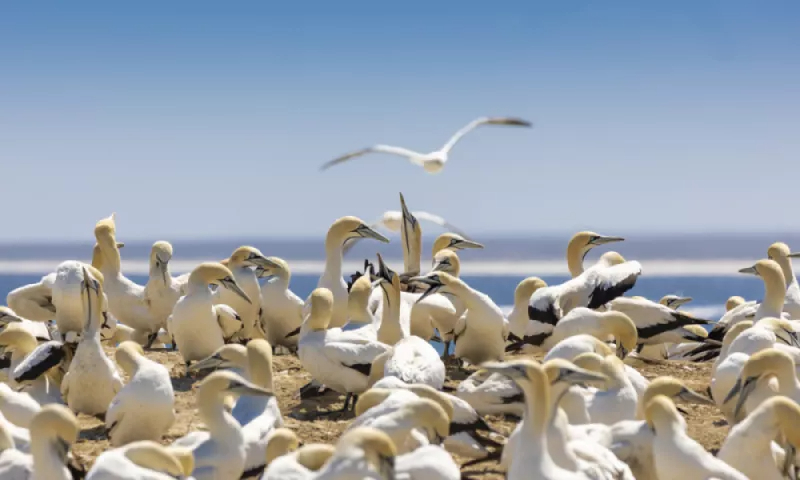

Over 43 000 Cape Gannets on Lambert’s Bay Bird Island this breeding season

Bird Island is alive with the sounds and spectacle of seabirds, with an estimated over 43 000 Cape Gannets currently making the island their home this breeding season. The thriving colony reinforces Bird Island, Lambert’s Bay, as one of South Africa’s most important gannet breeding sites and highlights the impact of ongoing marine conservation work.

The conservation team at Bird Island is encouraged by the sustained strong presence of gannets on the island. Work is currently underway to enhance population monitoring and improve the accuracy of long-term data. The Cape Gannet is listed as Endangered on the IUCN Red List and Vulnerable on the SANBI Red List.

Restoring and maintaining the gannet colony has not been without challenges. In December 2005, on-land seal predation caused the entire colony to abandon the island. Through careful management by CapeNature, mitigation measures were implemented to manage predators, and bird decoys were used to lure the birds back, enabling the colony to rebuild.

Over the past year, the population has increased to well into the 40 000s, compared to consistently remaining in the 30 000s over the previous five years. This notable growth is not only the result of local breeding success but also suggests that gannets from other colonies are selecting Bird Island as a preferred breeding site.

"This kind of sustained occupancy is a positive sign for the species and for the marine environment that supports them. Large, stable gannet colonies like the one on Bird Island are important indicators of ocean health along the West Coast. These seabirds rely on healthy marine ecosystems for their nutrition and breeding success, so when we see them in large numbers, it reflects a positive conservation outcome," said Dr Ashley Naidoo, CEO of CapeNature.

Early indications suggest this could be one of the strongest gannets fledging seasons in several years. To date, 7 647 fledglings have been recorded, with several weeks of the season still to go.

Gannet fledging is one of nature’s most extraordinary events. Young birds leave the safety of the colony to embark on a two- to three-year ocean-wide journey, returning only once they are ready to breed.

In partnership with the Department of Forestry, Fisheries and the Environment (DFFE), rangers have ringed 750 gannet chicks and 250 adult birds this season, contributing valuable data to national seabird research and monitoring programmes.

The island remains home to a diverse community of seabirds, including Cape, Crowned and White-breasted Cormorants; Common and Greater Crested Terns; Hartlaub’s Gulls; and Kelp Gulls. Adding a touch of character to the season, a moulting penguin has also taken up temporary residence, sheltering within the gannet colony.

Complementing these conservation efforts, Bird Island’s interpretive signage was updated and launched ahead of last year’s summer tourism season. The signage offers visitors fresh insights into the island’s inhabitants, history, and the role seabird colonies play in marine ecosystems.

With its remarkable seabird encounters, improved visitor facilities, and ongoing research efforts, Bird Island remains a must-see destination for anyone exploring the West Coast, particularly birders and nature enthusiasts eager to witness one of South Africa’s great seabird spectacles.

Western Cape adds 800+ posts to strengthen public healthcare system

The Western Cape Department of Health and Wellness is entering a new phase of stabilisation and strengthening of its health system, with more than 800 new posts being added to frontline and support services as part of the R34.47 billion Health and Wellness Budget for 2026/27. Over the next three years, the Western Cape will invest more than R106 billion to achieve a healthier Western Cape and a healthcare system that works better for everyone, everywhere.

This marks a decisive shift from crisis response to renewal, as the province balances the urgent needs of today with bold investments in the future of healthcare.

Western Cape Minister of Health and Wellness, Mireille Wenger, said the budget reflects a clear vision for the future. “We are moving beyond simply managing pressure. This budget allows us to actively stabilise and invest, and transform our health system so that it works better for every resident, at every stage of life.”

After years of sustained pressure from the COVID-19 pandemic, fiscal constraints, austerity, national policies that have limited workforce growth and rising demand, the system is beginning to stabilise. Now, the focus is on building a healthcare system that is more responsive, more resilient, and better able to meet the needs of every resident.

The addition of more than 800 posts, including 316 nurses, 124 doctors, 80 emergency medical personnel, 38 allied health professional and 278 support staff, will strengthen care where it matters most: at the frontline. It will ease pressure on facilities, improve patient experience, and support the more than 33 000 healthcare workers who continue to deliver care under demanding conditions. 

At the same time, this budget is about much more than numbers. It is about reshaping how healthcare is delivered.

“We are strengthening our frontline services today, but we are also investing in prevention, digital innovation, and modern infrastructure so that fewer people need hospital care in the first place, and those who do receive it faster, closer to home, and with dignity,” said Minister Wenger.

Over the past year, the system recorded more than 20 million patient contacts, underscoring both the scale of demand and the vital role of public healthcare in the province. 

The 2026/27 budget responds directly to this demand.

Primary healthcare services will be strengthened with an investment of R5.4 billion this financial year, bringing care closer to communities and placing greater emphasis on prevention and early intervention. Emergency medical services will be expanded, with additional personnel deployed in high-need areas and partnerships leveraged to improve patient flow and reduce waiting times.

At the same time, the province is investing in the future of care.

New digital platforms will make it easier for patients to navigate the health system, reduce congestion at facilities, and support clinicians with better access to information. These behind-the-scenes digital upgrades will be foundational to develop a healthcare system that can take advantage of every technological advancement. 

Crucially, prevention remains at the centre of the province’s long-term strategy, with sustained investment in vaccination, HIV and TB programmes, and community-based interventions designed to reduce pressure on the system over time.

“This is how we build a health system that lasts,” said Minister Wenger “By meeting the needs of today while investing in the systems, people and partnerships that will shape the next decade of healthcare in the Western Cape.”
error: eRadio is protected !
Scroll to Top