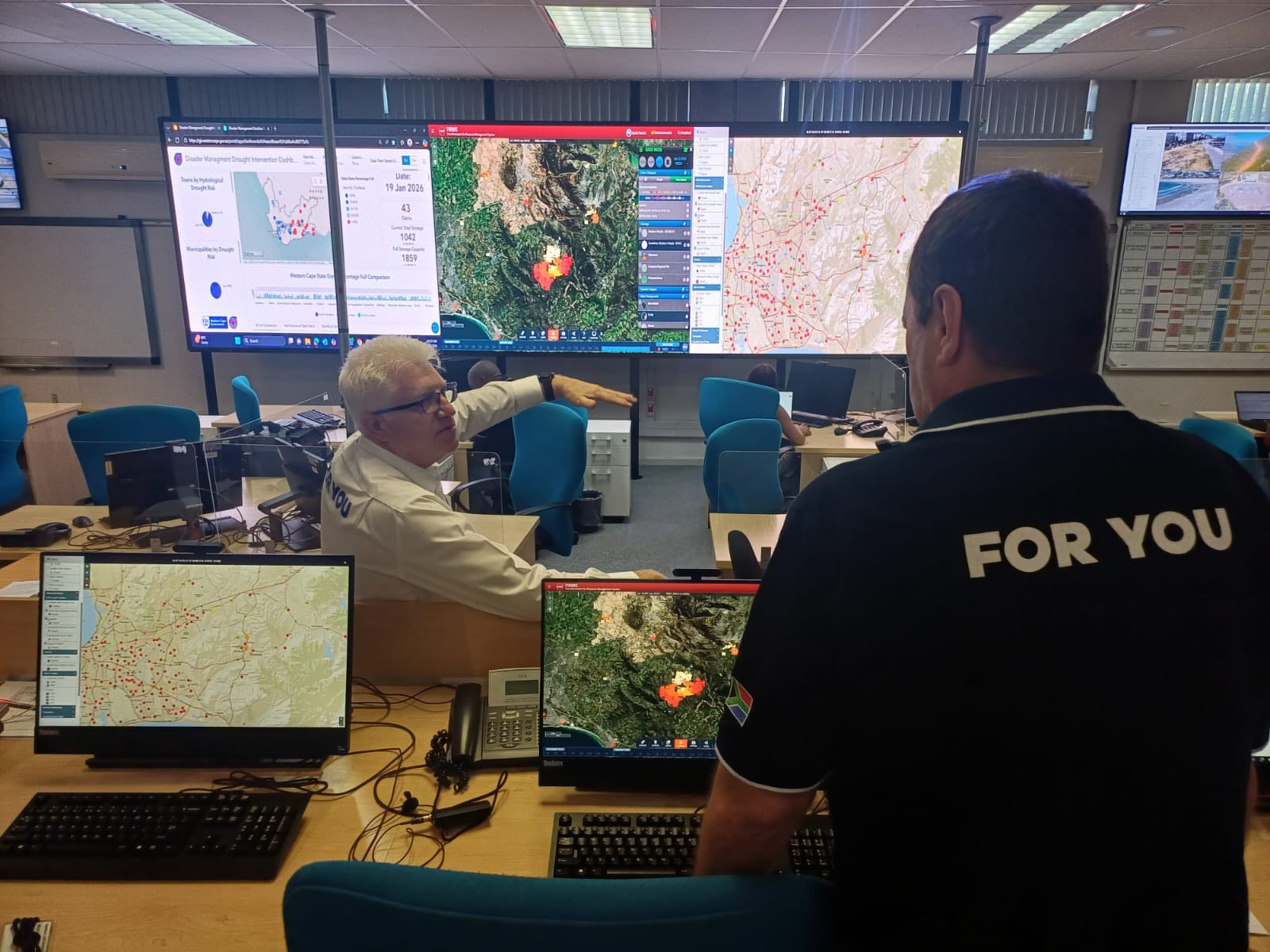
Premier Alan Winde today led a briefing to provide updates on the efforts of the Western Cape Government and its partners in tackling the ongoing wildfires ravaging parts of the province and the water security challenges impacting several municipalities.
The Premier confirmed that the 2025/26 fire season has been one of the most severe in a decade. To date, approximately 132 000 hectares of land has burned, making this the worst fire season since 2015. Multiple structures across the province have been destroyed, and a huge wildlife death toll. However, there have been no human fatalities, a testament to the coordinated efforts of emergency services and disaster management teams.
“When tackling disasters such as this, our sole priority is to protect lives and as far as possible infrastructure, including homes. It is deeply unfortunate that structures have been destroyed. But our main priority is ensuring public safety,” Premier Winde stated.
This fire season has recorded double the number of fires compared to the same period under review in the previous season, placing immense pressure on firefighting resources across the province.
Between 1 December 2025 and 11 January 2026, more than R19 million has been spent by the Western Cape Government on firefighting operations. Of this amount, R16 million was allocated to aerial firefighting resources, which have been critical in containing fires in hard-to-reach areas and protecting communities. Local Governments have probably spent triple that amount in funding their firefighting operations. The provincial government picks up the tab for the first hour of aerial firefighting.
"90% of fires are put out in the first hour. We are also keeping a close eye on the agriculture sector and will engage separately with stakeholders to address concerns from farmers and other role players.
Disaster declarations allow us to move budgets between departments so that we can bolster municipal firefighting operations, water infrastructure, and supply".
The firefighting response has involved more than 1 600 municipal firefighters, supported by an additional 1 000 Working on Fire personnel, who continue to work tirelessly under challenging conditions to contain blazes and safeguard lives, property, and critical infrastructure.
Premier Winde reiterated the province’s commitment to strengthening disaster response capabilities and urged residents to remain vigilant, comply with fire restrictions, and report any signs of fire immediately, while the provincial government continues to address both fire risks and ongoing water security challenges across affected municipalities.
First provincial Cabinet meeting of 2026 focuses on disaster response
Yesterday, Premier Winde chaired the first meeting of the Western Cape Government’s Cabinet for 2026.
“It has already been a challenging start to 2026. Ongoing violent crime, along with the wildfires and the water situation in some regions, are grim reminders that we dare not let our guard down, and as we enter a new year, we must continue to act with urgency to get things done,” he said as he opened the meeting.
Western Cape Government’s response to wildfires
While the combined response by the Western Cape Government and numerous stakeholders to the fires has been world-class, the severity and magnitude of the current fire season warrant it being classified as a provincial disaster.
Cabinet has requested a provincial disaster declaration from the National Disaster Management Centre (NDMC), in accordance with Section 23 of the Disaster Management Act. This will allow the provincial government to access emergency funding and to focus resources
For several months, the Western Cape has been experiencing severe fires due to the persistent hot, dry, and windy conditions across much of the province.
Cabinet noted with concern resource limitations by the provincial Department of Local Government, Environmental Affairs and Development Planning, as well as district municipalities in affected areas.
Projections indicate that the current fire season could extend into May 2026.
Western Cape Government’s response to Southern Cape drought
Cabinet also supported the request for a Provincial Disaster Declaration to the NDMC to sustain the ongoing response to the water security challenges across several regions.
A number of municipalities in the province are experiencing water security challenges, which require a coordinated response led by the provincial Department of Local Government, Environmental Affairs and Development Planning.
The Premier stated, “The request for a Provincial Disaster Classification is a preventative and risk management measure. It allows us to strengthen governance and sustain a coordinated response, desperately needed to mitigate the impact on residents, the economy, and infrastructure.”
While the Knysna Municipality is currently the hardest hit, a number of other municipalities are also affected. “This issue has become more widespread. We must escalate our responses,” added the Premier.
A disaster classification is a formal administrative determination by the NDMC to assess the severity and geographical spread of a disaster to determine which sphere of government is best placed to manage the situation within existing legislative mandates and resources.
Water restrictions are already in place in multiple municipalities.
The Premier stressed that while efforts to address natural and manmade disasters must be continuously scaled up, the Western Cape Government must also maintain its focus on programmes that mitigate the impact of the climate crisis.
Calls for Disaster Declaration on crime
Cabinet noted calls for a disaster declaration on crime.
This matter is receiving urgent attention. Crime prevention and law enforcement are national competencies, so this decision rests with national government. The Premier will be engaging with acting Minister of Police, Professor Firoz Cachalia, early next month, and the Minister of Cooperative Governance and Traditional Affairs, Velenkosini Hlabisa, where this matter will be discussed.
Cabinet expressed its deep gratitude to all emergency services personnel and stakeholders who worked tirelessly over the past festive period.
“Whether it was on the province’s roads, in our communities, at tourist attractions, or out in areas impacted by wildfires, we all stepped up to get the job done. Our traffic officials, healthcare workers, paramedics, firefighters, and disaster management teams continue to place themselves on the front line every day to protect lives, maintain order, and care for those in need. Your courage, professionalism, and commitment, often under extremely difficult and dangerous circumstances, do not go unnoticed. The Western Cape is safer and stronger because of you,” the Premier concluded
.
The Premier confirmed that the 2025/26 fire season has been one of the most severe in a decade. To date, approximately 132 000 hectares of land has burned, making this the worst fire season since 2015. Multiple structures across the province have been destroyed, and a huge wildlife death toll. However, there have been no human fatalities, a testament to the coordinated efforts of emergency services and disaster management teams.
“When tackling disasters such as this, our sole priority is to protect lives and as far as possible infrastructure, including homes. It is deeply unfortunate that structures have been destroyed. But our main priority is ensuring public safety,” Premier Winde stated.
This fire season has recorded double the number of fires compared to the same period under review in the previous season, placing immense pressure on firefighting resources across the province.
Between 1 December 2025 and 11 January 2026, more than R19 million has been spent by the Western Cape Government on firefighting operations. Of this amount, R16 million was allocated to aerial firefighting resources, which have been critical in containing fires in hard-to-reach areas and protecting communities. Local Governments have probably spent triple that amount in funding their firefighting operations. The provincial government picks up the tab for the first hour of aerial firefighting.
"90% of fires are put out in the first hour. We are also keeping a close eye on the agriculture sector and will engage separately with stakeholders to address concerns from farmers and other role players.
Disaster declarations allow us to move budgets between departments so that we can bolster municipal firefighting operations, water infrastructure, and supply".
The firefighting response has involved more than 1 600 municipal firefighters, supported by an additional 1 000 Working on Fire personnel, who continue to work tirelessly under challenging conditions to contain blazes and safeguard lives, property, and critical infrastructure.
Premier Winde reiterated the province’s commitment to strengthening disaster response capabilities and urged residents to remain vigilant, comply with fire restrictions, and report any signs of fire immediately, while the provincial government continues to address both fire risks and ongoing water security challenges across affected municipalities.
First provincial Cabinet meeting of 2026 focuses on disaster response
Yesterday, Premier Winde chaired the first meeting of the Western Cape Government’s Cabinet for 2026.
“It has already been a challenging start to 2026. Ongoing violent crime, along with the wildfires and the water situation in some regions, are grim reminders that we dare not let our guard down, and as we enter a new year, we must continue to act with urgency to get things done,” he said as he opened the meeting.
Western Cape Government’s response to wildfires
While the combined response by the Western Cape Government and numerous stakeholders to the fires has been world-class, the severity and magnitude of the current fire season warrant it being classified as a provincial disaster.
Cabinet has requested a provincial disaster declaration from the National Disaster Management Centre (NDMC), in accordance with Section 23 of the Disaster Management Act. This will allow the provincial government to access emergency funding and to focus resources
For several months, the Western Cape has been experiencing severe fires due to the persistent hot, dry, and windy conditions across much of the province.
Cabinet noted with concern resource limitations by the provincial Department of Local Government, Environmental Affairs and Development Planning, as well as district municipalities in affected areas.
Projections indicate that the current fire season could extend into May 2026.
Western Cape Government’s response to Southern Cape drought
Cabinet also supported the request for a Provincial Disaster Declaration to the NDMC to sustain the ongoing response to the water security challenges across several regions.
A number of municipalities in the province are experiencing water security challenges, which require a coordinated response led by the provincial Department of Local Government, Environmental Affairs and Development Planning.
The Premier stated, “The request for a Provincial Disaster Classification is a preventative and risk management measure. It allows us to strengthen governance and sustain a coordinated response, desperately needed to mitigate the impact on residents, the economy, and infrastructure.”
While the Knysna Municipality is currently the hardest hit, a number of other municipalities are also affected. “This issue has become more widespread. We must escalate our responses,” added the Premier.
A disaster classification is a formal administrative determination by the NDMC to assess the severity and geographical spread of a disaster to determine which sphere of government is best placed to manage the situation within existing legislative mandates and resources.
Water restrictions are already in place in multiple municipalities.
The Premier stressed that while efforts to address natural and manmade disasters must be continuously scaled up, the Western Cape Government must also maintain its focus on programmes that mitigate the impact of the climate crisis.
Calls for Disaster Declaration on crime
Cabinet noted calls for a disaster declaration on crime.
This matter is receiving urgent attention. Crime prevention and law enforcement are national competencies, so this decision rests with national government. The Premier will be engaging with acting Minister of Police, Professor Firoz Cachalia, early next month, and the Minister of Cooperative Governance and Traditional Affairs, Velenkosini Hlabisa, where this matter will be discussed.
Cabinet expressed its deep gratitude to all emergency services personnel and stakeholders who worked tirelessly over the past festive period.
“Whether it was on the province’s roads, in our communities, at tourist attractions, or out in areas impacted by wildfires, we all stepped up to get the job done. Our traffic officials, healthcare workers, paramedics, firefighters, and disaster management teams continue to place themselves on the front line every day to protect lives, maintain order, and care for those in need. Your courage, professionalism, and commitment, often under extremely difficult and dangerous circumstances, do not go unnoticed. The Western Cape is safer and stronger because of you,” the Premier concluded
.

