Volkswagen Group Africa celebrates production of 500 000 Polos for export

Volkswagen Group Africa (VWGA) has reached another major milestone with the production of the 500 000th unit of the current Polo for the export market. The milestone vehicle was a Crystal Ice Blue, right-hand-drive Polo destined for the United Kingdom, which is one of VWGA’s main export markets.

The current Polo has been in production at Plant Kariega since 2021. On average it takes three days and 1 985 sets of hands to build one Polo, with around 1 400 individual parts coming together to create this popular Volkswagen model. Over the past 30 years, four generations of the Polo have been produced in Kariega, showing the plant’s long-standing stature of building this iconic model.

In 2024, Plant Kariega became the sole global exporter of the Polo to 38 international markets. Earlier this year, the Polo was voted “Best Small Car” in the 50th edition of Auto Motor und Sports Best Cars readers poll, which is the largest car reader survey in Europe. Additionally, the Polo was recently announced by CAR as the winner in the Small Cars segment in its 2026 Top 12 Best Buys.

The Polo remains a favourite in South Africa. At the point of achieving this milestone, VWGA had produced 2 044 761 Polos in Kariega. Of these, 596 631 were sold in the local market, while 1 448 130 have been exported. The current facelift Polo accounts for 51.2% of all Polos built for export since 1996.

Germany is now the biggest export market for the Polo, with 124 711 vehicles shipped between 2020 and 2026, followed closely by the United Kingdom at 113 171 units.

2026 is a special year for VWGA; not only does the company celebrate 75 years of building vehicles in South Africa, it also marks 30 years of Polo production in Kariega. 

“Reaching the milestone of producing the 500 000th current generation Polo is a proud moment for our Production and Logistics team,” said Ulrich Schwabe, VWGA Production Director. “This milestone shows the hard work, skill, and dedication of every employee at Plant Kariega. Our people have dedicated three decades to building and delivering this beloved vehicle to our customers, and these teams are the reason the Polo continues to shine, both here at home and across the world.”

Western Cape records 14% drop in Easter road fatalities

The Western Cape Government has recorded a 14% drop in road traffic deaths over the 2026 Easter period, thanks to increased visible traffic policing and stricter enforcement. 

Traffic officers had a busy week, stopping and checking 44 555 vehicles and making 149 arrests, including 108 for driving under the influence. In a firm stance against corruption, two drivers were arrested in Citrusdal and Worcester on Saturday and Sunday for allegedly attempting to bribe traffic officers.

In a separate incident, a driver was arrested near Laingsburg on Saturday for allegedly assaulting a traffic officer, driving under the influence, failing to provide his name and address, and resisting arrest.

Sadly, 19 people lost their lives on the province’s roads, compared to 22 during the same period last year.

While this is an improvement, the Western Cape Government remains deeply concerned that pedestrians and passengers remain the most vulnerable road users, accounting for the vast majority of fatalities.

“This past weekend, I joined traffic officers at various roadblocks and was encouraged by the overall compliance from most motorists. However, there were still some serious concerns, including drivers getting behind the wheel under the influence, bribing and assaulting traffic officers, and allowing unlicensed drivers to operate minibus taxis carrying passengers. These are the reckless risks our traffic officers are working hard every day to prevent.

“The decrease in fatalities is an encouraging result and shows that stronger enforcement by our traffic officers and better behaviour by road users are making a difference. This includes a 36.1% drop in driving under the influence of alcohol arrests, suggesting that constant visible policing is effectively discouraging risky behaviour. We thank residents and visitors who played their part in keeping our roads safer during this busy period,” said Western Cape Minister of Mobility, Isaac Sileku.

Driving under the influence remains a serious concern. A total of 108 drivers were arrested, with the highest alcohol reading recorded in Vredendal at 1.46 mg/l, more than five times the legal limit. Traffic officers also removed 293 unroadworthy vehicles from the roads and identified 1 778 unlicensed vehicles, highlighting a serious compliance gap and the risk posed by unsafe and potentially uninsured vehicles.

Despite adverse weather on Good Friday, especially along the N1 and in Cape Town, operations continued unabated. Innovative technology played a key role, as drones were used to monitor pedestrian movement and public transport areas. Despite these efforts, 9 pedestrians and 7 passengers tragically lost their lives. Many of these incidents involved pedestrians walking on high-speed roads, often under the influence of alcohol.

Although total arrests dropped by 29%, indicating some improvement in behaviour, the Western Cape Government warns that speeding, reckless and negligent driving, not wearing seatbelts, and driving or walking under the influence of alcohol remain major risks.

“Our high-visibility approach is working, but road safety is a shared responsibility. We urge residents and visitors to wear seatbelts, never drink and drive, avoid walking while intoxicated, and always follow the rules of the road,” said Maxine Bezuidenhout, Chief Director of Traffic Management.

SAWS releases seasonal climate forecast

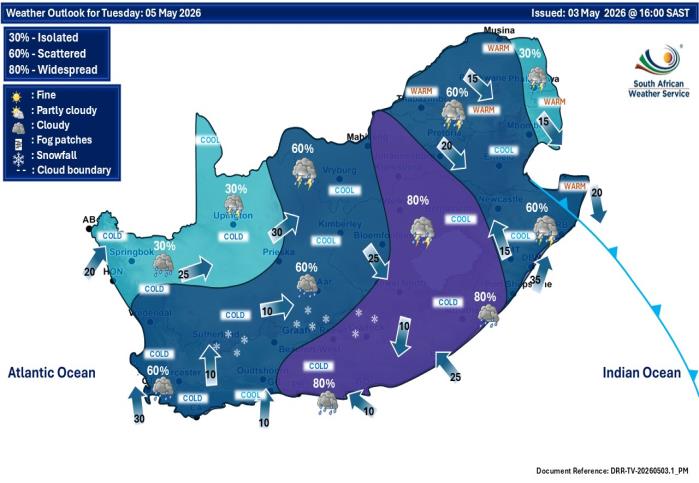
The South African Weather Service (SAWS) forecast indicates that warmer conditions are expected in most parts of the country in the late autumn and winter, while significant rainfall is expected mainly over the southern and eastern coastal parts of South Africa.

In its seasonal climate watch released on Tuesday, the weather service said the El Niño-Southern Oscillation (ENSO) is currently still in a neutral state.

Current predictions indicate a rapid shift over the next few months toward an El Niño state [associated with hotter and drier conditions], with further strengthening expected through spring and into the start of the next summer season.

“Caution is advised, however, as the prediction skill of the ENSO phenomena can be limited during the winter months, and therefore it is highly recommended to keep track of the forecasts during and after winter,” SAWS said.

Above-normal rainfall is expected over the south-eastern and eastern coastal areas during late autumn, with the eastern coastal areas remaining likely to receive above-normal rainfall during the winter season.

“This is likely to bring positive impacts for crop and livestock production. However, the south-western part of the country, which normally receives significant rainfall during the winter season, is expected to receive below-normal rainfall during this period. 

“Therefore, the relevant decision-makers are encouraged to advise farmers in these regions to practice soil and water conservation, proper water harvesting and storage, and other appropriate farming practices,” SAWS said.

The weather service warned that the wetter-than-normal conditions may increase the risk of localised flooding, temporary waterlogging, and poor drainage in vulnerable coastal and low-lying areas, particularly in settlements located near rivers, estuaries, and flood-prone zones. 

Such conditions may elevate the potential for waterborne disease outbreaks, contamination of water sources, and water-related injuries or accidents. 

In contrast, the south-western and southern coastal regions are expected to receive below-normal rainfall during winter, which may place pressure on local water availability and hygiene conditions in some communities if dry conditions persist.

Minimum and maximum temperatures are also expected to be above normal across most parts of the country during autumn and early winter. 

These warmer-than-usual conditions may increase the risk of heat-related illnesses, especially among vulnerable groups such as older persons, young children, people with chronic illnesses, and those working outdoors. 

Elevated temperatures may also heighten exposure to ultraviolet (UV) radiation, increasing the likelihood of sunburn, skin damage, and other UV- related health impacts. 

“Communities are therefore encouraged to remain alert to both heat- and rainfall-related health risks by staying hydrated, limiting unnecessary exposure to heat, using sun protection, avoiding flooded areas, and ensuring safe water and sanitation practices. 

“Health authorities and disaster management structures are advised to strengthen public health messaging and ensure the timely dissemination of heat-health information, flood alerts, and hygiene awareness measures to support preparedness and response,” SAWS said. 

The forecast is updated monthly, and users are advised to monitor the updated forecasts, as there is a possibility for them to change, especially the longer lead-time forecasts.  

“Moreover, farmers are advised to keep monitoring the weekly and monthly forecasts issued by the SAWS. Farmers are also advised to keep monitoring advisories from the Department of Agriculture, Land Reform and Rural Development, and make the necessary adjustments accordingly,” the weather service said. 

Western Cape allocates R22m for livestock drought relief

The Western Cape Department of Agriculture has approved R22 million in risk reduction funding to provide fodder support to livestock farmers affected by ongoing dry grazing conditions linked to climate variability.

In a statement issued on Wednesday, the department said extended periods of limited rainfall have placed significant pressure on grazing veld across several regions, negatively affecting livestock conditions and threatening farm sustainability.

Agriculture, Economic Development and Tourism MEC, Dr Ivan Meyer, said livestock farmers are under real pressure because of prolonged dry conditions.

“This intervention is about acting early to protect herds, livelihoods and grazing resources. We cannot allow short-term climate shocks to undermine the long-term sustainability of agriculture in the Western Cape,” Meyer said.

Meyer said the department is implementing this intervention to reduce immediate pressure on natural grazing resources and stabilise production systems ahead of the winter season.

He said the fodder support forms part of the department’s broader risk reduction strategy.

“By easing pressure on natural grazing now, we help farmers bridge difficult conditions while safeguarding the veld so that it can recover when rains return. Climate variability is no longer a future threat; it is already shaping farming conditions across our province,” the MEC said.

While stressing the need for a decisive government response, Meyer also highlighted the importance of collaboration with farmers to build “resilience into our production systems”.

The department has encouraged livestock farmers to apply for the available relief and to continue implementing sustainable grazing and veld management practices, as part of long-term climate resilience planning.

SA welcomes Middle East ceasefire, calls for lasting peace

President Cyril Ramaphosa has welcomed the announcement of a ceasefire in the Middle East, expressing hope that it will pave the way for a permanent resolution to the conflict.

Speaking during the Credentials Ceremony at the Sefako Makgatho Presidential Guesthouse in Pretoria on Wednesday, President Ramaphosa said South Africa supports ongoing efforts to end hostilities.  

“We note the current initiatives and ongoing efforts aimed at achieving a comprehensive end to the conflict in the Middle East.

“We welcome the announcement of a ceasefire and are hopeful that it will lay the basis for a permanent resolution of the conflict,” the President said. 

President Ramaphosa reiterated South Africa’s long-standing position that peace should be achieved through dialogue rather than force. 

“South Africa once again calls for dialogue and mediation to prevent further loss of life and destruction of property, and to ensure a just, sustainable and lasting peace,” he said.

South Africa has persistently stood at the helm of calls for a ceasefire in the Middle East, maintaining that dialogue remains the only viable path toward a sustainable solution, and that no military intervention can deliver lasting peace. The country has further urged for a universal and unequivocal recognition of United Nations resolutions on peace and conflict resolution, which are meant to advance civilian protection and brokering ceasefire deals. 

In Pretoria today, President Ramaphosa once again called on all countries to uphold international law and respect sovereignty.

“We further call on all countries to respect international law and the sovereignty and territorial integrity of all nations.”

The President said South Africa’s international relations outlook is grounded in the values of its Constitution, including human dignity, equality and freedom.

“As a nation that emerged from a painful past of injustice and inequality, we seek a more just and equitable world order. We seek a global order defined by peace and friendship amongst all the nations of the world,” he said. 

President Ramaphosa stressed that global peace and security should be achieved through cooperation and adherence to international agreements.

“We strive to ensure that global peace and security is secured through dialogue and negotiation and not through force of arms – where international laws, treaties and agreements are upheld and respected,” the President said. 

He added that in a complex and interconnected world, global solidarity, multilateral diplomacy and respect for the multilateral system remains key to addressing challenges such as conflict, poverty and inequality. 

“In a world beset by profound and interconnected challenges – whether they be conflicts, the climate crisis or the proliferation of poverty and inequality – we know that global solidarity and deepening cooperation are our surest means to overcome them,” he said. 

Central Karoo Flying Squad Confiscates Drugs Worth R165 000 at Prince Albert


Members of the Central Karoo Flying Squad have confiscated drugs with an estimated street value of R165 000 during crime-combatting operations at Prince Albert in the Western Cape.

Police conducted a vehicle checkpoint on the N1 at the entrance to Prince Albert on Monday, 6 March 2026, when they stopped a passenger bus. During the search, officers noticed a passenger jumping over a nearby farm fence and fleeing the scene.

Police gave chase and, with the assistance of the farm owner, managed to apprehend the suspect. Investigations later linked the man to a travelling bag found on the bus that contained two bales of dagga.

The drugs were confiscated and the 29-year-old suspect was arrested on a charge of dealing in drugs.

He remains in custody and is expected to appear in the Prince Albert Magistrate’s Court on Wednesday, 8 April 2026.

5 Essentials you should never travel without

As Easter weekend approaches and schools being to close for the Ester break, South Africans will be leaving to go on holiday or visit families. Yet, every Easter, the results of this are devastating. The Road Traffic Management Corporation (RTMC) consistently records Easter as the second deadliest period on South African roads.

Hundreds of fatalities are recorded over just four days. MasterDrive’s CEO, Eugene Herbert, expands: “What often does not get enough attention is the practical, road-specific tools that can make the difference between a close call and a tragedy. As you prepare for your Easter trip, ensure you have these five essentials packed.”

A tyre pressure gauge
Tyre blowouts remain a major cause of accidents in South Africa, particularly along long stretches of the N1, N2 and N3 during peak periods. “Many drivers assume their tyres are in good condition simply because they look fine or because the tyre pressure monitoring system has not issued an alert.
“Yet, a tyre can be dangerously underinflated without showing visible signs. Compounding the risk, filling station pressure gauges are notoriously unreliable. Do not solely depend on them. An inexpensive pressure gauge, used before departure and checked regularly throughout a trip, can make a critical difference. It costs far less than the consequences of neglect,” says Herbert.

Download offline GPS
Cell signal drops in areas like the Hex River Mountains, the Drakensberg foothills and along long stretches of the Eastern Cape. “When it does, drivers unfamiliar with the route make sudden decisions.
“Unexpected U-turns, last-minute lane changes, or stopping on the road shoulder are common crash triggers. A downloaded offline map keeps you navigating confidently through dead zones,” says Herbert.

Tyre sealant or portable compressor
A flat tyre on a busy holiday route is not just an inconvenience but a hazard. “Many newer vehicles no longer have a spare wheel, and waiting for roadside assistance on a public holiday can take hours with traffic flying past. A can of tyre sealant or a compact 12V compressor can change that.
“If you have a ‘biscuit’ spare tyre or run flats, read the owner’s manual to ensure you understand the limitations of these wheels and do not exceed this,” says Herbert.

A warning triangle and reflective vest
This is legally required but frequently absent. “If you need to stop in an emergency, these items are essential to ensuring you are visible, especially at night. Place the triangle at least 30 metres behind your vehicle on highways to give drivers plenty of time to react,” says Herbert.

Power banks or charging cords
Ensure you have a full battery in case of an emergency. “Reserve a power bank solely for the road. Alternatively, ensure you have a working charging cord that suits the charging port in the vehicle,” says Herbert.

SARS exceeds R2 trillion in 2025/26 net revenue collection

The South African Revenue Service (SARS) has collected some R2.010 trillion in net revenue for the 2025/26 financial year, breaking the threshold for the first time since its inception.

The historical milestone was announced by SARS Commissioner Edward Kieswetter during a presentation of the preliminary revenue outcome for the financial year on Wednesday.

Collections at SARS have grown at a compound annual growth rate of 5.8% since the start of Kieswetter’s tenure seven years ago.

“This is a historic milestone of crossing [the] R2 trillion threshold for the first time in our history. Indeed, a defining moment. This is R155 billion more than what we collected a year ago, a remarkable year-on-year growth of 8.4% under these economic conditions where nominal growth, for now, is projected to have grown at 4%.

“This implies a tax-to-GDP [Gross Domestic Product] ratio of 25.9% and tax buoyancy ratio of 1.73%,” Kieswetter said.

The largest contributors to the collection were individual taxes at R794 billion followed by Value Added Tax (VAT) at R500 billion, company taxes stood at R350 billion while customs reached R352 billion and excise stood at R182 billion.

Kieswetter noted that refunds stood at R458 billion at year’s end.

“Refund payments…especially during tough economic times for small businesses and families in financial stress, are an important lifesaver and a necessary injection of cash into the economy.

“The fact that the R458 billion refunds that we processed represents 5.9% of GDP. So, I am therefore pleased that our growth in refunds has consistently grown higher than gross or net revenue. This even after we’ve consistently increased refund risk management to deal with impermissible and fraudulent refund claims,” he said.

The revenue collector took some 22 years to reach the R1 trillion threshold and just ten years to double the collection to R2 trillion despite the effects of slow economic growth, load shedding and COVID-19.

“We believe that this is noteworthy and reflects the diligent work of our employees, the institutional integrity of SARS and the tax administrator centrality to the fiscal health of South Africa.

“SARS is truly a national asset that must never be taken for granted and must be treasured,” the Commissioner added.

A worthy farewell

Kieswetter will be ending his tenure as Commissioner of the revenue service at the end of this month with an announcement of his replacement to be announced by President Cyril Ramaphosa.

“As I come to the end of the seven years of national service, I recall the President’s challenge to those who cared about the future of South Africa and the generations to come to step forward, to leave behind a comfortable life of retirement, and take their place at the forefront of the struggle where real change happens.

“It was a call to service, a call to restore credibility and the capability of our damaged institutions, succinctly captured in the call ‘Thuma Mina’.

“I want to thank the President, the Minister [of Finance], and all South Africans for affording me the rare privilege to make my humble contribution to the wellbeing of our country and its people. I am filled with immense pride that thankfully, together with the help of the people at SARS, we have given our best to the nation,” he said.

The Commissioner encouraged all taxpayers to remain compliant while praising employees at the revenue service.

“Collecting over R2 trillion is not an accident, but the outcome of the more than 14 500 employees who diligently perform millions of activities meticulously to achieve this record collection.

“Every rand not only helps build a capable state that honours the social contract but also enables the state to deliver for all South Africans and strengthen fiscal integrity of South Africa.

“The record achievement we reached today is because of all compliant taxpayers; I would like to thank them for their fiscal citizenship and contribution to help the most vulnerable in our society,” Kieswetter concluded.

SA vehicle sales hit 20-year high, but rocky road ahead for motorists

South Africa’s new vehicle market delivered its strongest March in nearly two decades, with domestic sales reaching 58,060 units according to naamsa the Automotive Business Council. This represents a 17.3% increase on the 49,500 units sold in March 2025, supported by cumulative interest rate cuts and firmer consumer and business sentiment, even as cost pressures begin to build.

March 2026 is the strongest performance for the month since 2007. Year-to-date volumes now stand at 161,978 units, 12.4% ahead of the same period last year. Dealer channels accounted for 88.7% of total sales, indicating that retail demand continues to underpin the market.

“March is a result worth noting. The market hasn’t seen numbers like this in nearly two decades, pointing to stronger domestic demand. Successive rate cuts since late 2024 are clearly feeding through, lifting both consumer and dealer confidence. The environment, however, is changing.

April introduces new pressure that households and the industry will need to manage carefully,” says Lebogang Gaoaketse, Head of Marketing and Communication at WesBank.

The March outcome precedes a marked shift in the cost environment. From 1 April, petrol increased by R3.06 per litre, while diesel rose by between R7.37 and R7.51 per litre, reflecting higher global oil prices linked to conflict in the Middle East. The average Brent crude price increased from $69.08 to $93.67 per barrel over the pricing period, with currency weakness adding to the impact. A temporary R3.00 per litre reduction in the general fuel levy provides short-term relief but is due to expire on 5 May 2026 and does not offset the full increase.

Passenger vehicle sales reached 39,370 units, up 18.2% year-on-year, with car rental accounting for 6.5% of volumes, suggesting that retail demand is carrying the bulk of growth. Light commercial vehicles recorded 15,557 units, up 15.7%, while medium commercial vehicles increased by 14.0% to 823 units. Heavy trucks and buses rose 14.5% to 2,310 units. Dealer confidence also reached a 13-year high of 67 index points, consistent with the improvement in trading conditions.

“The fuel and energy increases coming through in April present a clear headwind for consumers who were only starting to benefit from earlier rate cuts. Our focus remains on structuring finance in a way that is sustainable over time, taking into account total cost of ownership rather than purchase price alone,” says Gaoaketse.

Higher electricity tariffs will add to pressure on both households and businesses. The combined effect is likely to feed through into transport costs, food prices and overall living expenses, placing further strain on disposable income.

“A first quarter of this quality provides a solid base for the year. The underlying drivers of demand remain in place, and WesBank will continue to support customers with finance solutions aligned to their circumstances as conditions evolve,” he says.

SAWS warns of scattered showers ahead of Easter travel period

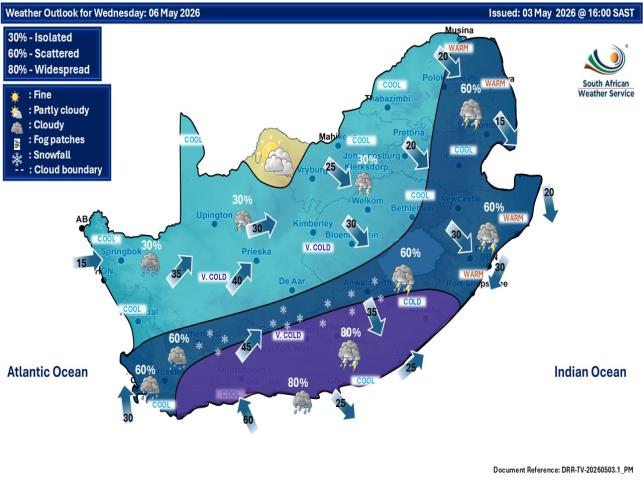
The South African Weather Service (SAWS) has forecast partly cloudy conditions with isolated to scattered showers and thundershowers across parts of the country on Thursday and Friday, as many South Africans prepare to travel for the Easter period.

In its latest weather outlook, SAWS said conditions will be cool to warm in most areas, but hot in some regions, with a higher likelihood of scattered showers in the western parts of the country.

The forecast comes as increased traffic volumes are expected on major routes, with authorities urging motorists to plan their journeys carefully and remain weather-aware.

Safety focus for Easter travellers

With changing weather conditions, SAWS is encouraging travellers to prioritise safety on the roads, particularly in areas prone to thunderstorms and reduced visibility.

The weather service encourages travellers to download its WeatherSmart app which will help in detecting weather conditions ahead of time.

“Headed somewhere this Easter? Our weatherSmart App helps you know when to stop, stay safe from lightning and arrive relaxed. Your safety travel this Easter is only as good as your data,” the weather service said in a post on X, highlighting the importance of using reliable weather data to make informed travel decisions. 

The WeatherSmart App is among the tools being promoted to help motorists track conditions in real time. According to SAWS, the app enables users to monitor weather patterns, identify when it may be safer to delay travel, and stay alert to lightning risks.

Lightning awareness and verification

As thunderstorms are expected in some areas, SAWS has also emphasised the importance of lightning awareness, particularly for those travelling long distances or leaving property unattended.

The service offers a Lightning Verification Report at a fee, which can confirm whether a lightning strike occurred at a specific location a tool aimed at helping citizens protect valuable assets and support insurance claims if needed.

SAWS has urged the public to stay updated through official weather platforms and to adjust travel plans where necessary. 

With variable conditions expected over the Easter period, travellers are advised to remain cautious, take regular breaks, and ensure their journeys are guided by up-to-date weather information to arrive safely at their destinations.
error: eRadio is protected !
Scroll to Top