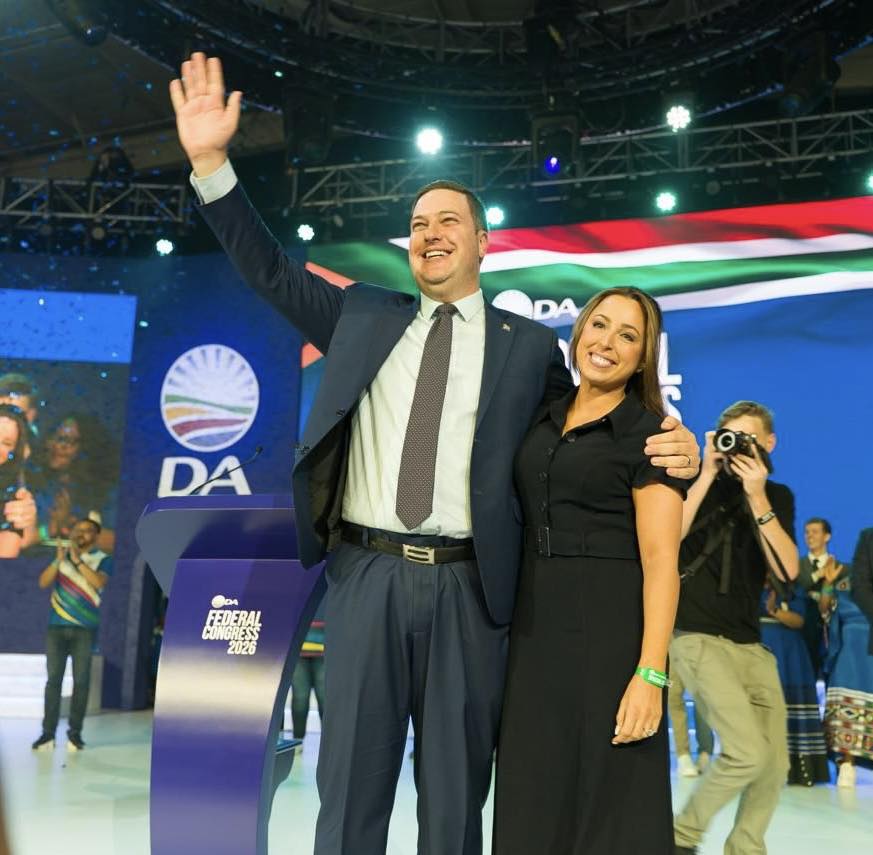
Cape Town Mayor Geordin Hill-Lewis has been elected leader of the Democratic Alliance (DA).
Hill-Lewis defeated Sedi-beng caucus leader Sibu-siso Dyo-nase.
The Cape Town Mayor says he will do everything in his power to ensure the party helps shape the direction the government takes, reflecting the DA’s values.
Here's his full acceptance speech:
Friends, democrats, people of South Africa,
Bahlobo, Bantu baseMzansi Afrika,
Vriende, wonderlike mense van Suid Afrika
I am deeply honoured to be standing here today.
Thank you to my beautiful wife Carla, who you just met, and our amazing daughter who is watching at home. They are my biggest supporters, I love them so much, and they are the inspiration for all that I do.
My mom is also watching from home and, while my dad has passed away, I know he is watching us here. I’m so grateful to both of them for the values they taught me, that guide me in life today.
I must say something to Solly Malatsi, who is our Minister of Communications. I have never told anyone this story, but when I ran in my first election my dad cut a job advert out of the newspaper and gave it to me with a handwritten note. It was a vacancy at the SA Post Office, and his note said: “Son, please rather apply for this job, because politics is too stressful.”
I’m sorry I didn’t listen dad, but I know you are proud now.
My sincere ‘thank you’ to all the delegates of the Democratic Alliance for placing your trust in me.
I accept this responsibility with humility, with gratitude, and with a deep sense of duty.
I stand before you as your newly elected leader with one promise:
However long I have the privilege of serving in this job, I will be dedicated to the mission of building a stronger South Africa for everyone.
South Africa is worth it. We have a great country. And we are a great people. We all love this country too much to see it fail. Together we will build a stronger South Africa. And, to do that, we will build a stronger Democratic Alliance.
But before I speak about the future, I would like to reflect for a moment on how we got here.
A legacy of leadership
The Democratic Alliance did not become the party it is today by accident. It was built over many years by leaders who each strengthened this party in different ways, often in difficult times, and against the prevailing tide.
Our party’s roots run deep. From the formation of the Progressive Party sixty-seven years ago – and Helen Suzman’s often lonely fight as a liberal voice standing against Apartheid – to the Democratic Party which played an outsized role in shaping our Constitution and our new South Africa.
One of the architects of that document, when he was even younger than I am now, was Tony Leon.
Later, as leader, Tony went on to take a party with just 1.7% of the vote and make it electable by turning it into a fearless party of opposition. At a time when many believed that South Africa did not need a strong opposition, Tony insisted that our democracy could not succeed without one.
I remember watching Tony debate President Thabo Mbeki when I was just sixteen years old. While President Mbeki eloquently defended the brutality of the Mugabe regime and denied the truth of the AIDS pandemic, Tony stood up and said what others were unwilling to say: that defending Mugabe was indefensible, and AIDS was a crisis causing untold loss and grief.
I remember watching on tv – completely mesmerised by the quality of the debate. Here were two leaders engaging not in a war of words, but in a battle of ideas, about the future and the values that should guide our country. Tony understood that democracy required someone willing to speak uncomfortable truths. Someone willing to say what others will not say, and to challenge power.
Tony Leon laid the foundation for the modern DA by proving that opposition matters, and that principled opposition is never unpatriotic. On the contrary: principled opposition is loyalty to the Constitution.
After Tony came Helen. In 2004, I attended a DA Youth meeting in Bonteheuwel. At the time, I was still a schoolboy, trying to understand what the DA was all about. There I remember meeting someone I had never heard of before: a Member of Parliament called Helen Zille.
We spoke for a long time that afternoon about politics, and activism, and the work she was doing in communities across the Cape Flats.
I remember walking away from that conversation slightly star-struck: it was the first time I had ever met a real-life Member of Parliament.
But what struck me more was Helen’s ability to connect with people. She was as comfortable speaking to residents on their doorsteps, as she was debating in the National Assembly.
Daai dag in Bonteheuwel sal altyd met my bly.
The following year, in 2005, I began my studies at UCT.
And when I arrived there, I discovered something surprising: there was no alternative at all to the ANC-aligned student wing called SASCO. No opposition. No competing ideas.
Tony Leon had taught us that democracy cannot function without opposition.
So it seemed obvious to me that something had to be done about this.
So we started a DA students organisation on campus, and DASO was born.
Now I wish I could tell you that we came out of nowhere and swept the floor with our opponents. But let me tell you, friends, our first election was a disaster. We were thoroughly defeated.
That experience taught me an important lesson about politics and about life.
There are moments when the cause you believe in suffers defeat. When the odds seem overwhelming. When it seems easier to walk away.
But those are the moments when the commitment to our cause matters most.
Theodore Roosevelt once spoke about the man in the arena – the person who strives valiantly, who errs and comes short again and again, but who commits themselves to a worthy cause.
That idea shaped my political journey from early on.
So we built on our lessons, and we worked hard, with focus and discipline. The next year we won two seats, and just a year later DASO won the SRC Presidency for the first time on any campus in SA.
I saw then that the idea that the ANC was the natural and permanent party of government – that its dominance was inevitable – was simply not true.
The ANC could be beaten.
Around that same time, Helen Zille was demonstrating the very same lesson on a much larger stage.
In 2007 I was here among the crowds at Gallagher Estate in this very hall when Helen Zille was elected leader of the DA.
Under her leadership our party transformed itself from a party known as a strong opposition, to a party that could govern.
In cities, towns, and provinces the DA began to show South Africans something new.
That good government was possible, and institutions could work.
That public money could be spent on the people it belongs to.
And that a government that serves people with integrity can restore hope where decline once seemed inevitable.
Helen Zille proved that strong opposition is not enough.
A party must also prove that it can govern.
Helen did this – and not without a fight.
We respect all who have led our party through its history. When Mmusi Maimane became the leader of the DA, I had the privilege of serving as his Chief of Staff.
During that time, I learned something that shaped my understanding of leadership: I learned that politics is not only about policy or ideas, it is about people.
Mmusi had an ability to connect with South Africans from every background and every community. He reminded all of us that a political movement must remain rooted in the lives and experiences of the people it seeks to serve.
He brought a new voice, a new energy and new ambition to our party.
That chapter remains an important part of the DA’s journey.
And then came John Steenhuisen.
John took the next great step in the story of this party.
John led the DA into national government for the first time in our history.
When he became leader in 2019, the DA faced a difficult time. Many commentators predicted the decline, even the collapse, of our party.
But John steadied the ship.
He rebuilt the party’s confidence, strengthened our leadership team, and prepared the DA for a new era in South African politics: the era of national coalitions.
And in 2024, under John’s leadership, the DA entered the Government of National Unity and began shaping the direction of national government for the first time.
That achievement will stand as one of the most important milestones in the history of this party.
John showed that the DA would never be content to shout from the sidelines while our country fell deeper into decline.
John said: “We are here to govern. We are here to make a difference.”
And John deserves our thanks and our gratitude for leading the party to that moment.
You see, each generation of leaders has built something that the next generation could build on. Each generation of leaders deserves our gratitude. Let us take a moment together now to show our honour and respect for them all.
A new chapter
And now the question before me – before us – concerns the next chapter in our party’s story.
The question is not whether we can oppose, or whether we can govern.
The question is whether the DA can lead the country.
Whether we can become the largest party in national government.
And, as your newly elected leader, my answer is a resounding “YES!” Yes we can.
That is the mission you have assigned to me: To grow the DA into the largest party in South Africa.
And to lead a new national government.
Everything I do, as your leader, will be to complete that mission.
How we will win
To win, we must do four things.
The first is this: we must continue to show that the DA governs well – for everyone.
Where the DA governs, the basics work.
Budgets are managed responsibly.
Competent people are appointed.
Institutions function.
Services are delivered.
And when we do the basics well, it is the poor who benefit the most.
Because, getting the basic rights means the economy grows and jobs are created.
When the fire department answers your calls and actually sends help when you need it.
When the local clinic treats you with respect and gives you care you deserve.
When you have growing access to the dignity of basic services.
When your community is cleaner.
These things make life better for all, and especially for the poor.
Over the past four years as Mayor of Cape Town I have worked hard every day to demonstrate that we govern well for everyone.
We are fixing broken sewers.
We built better public transport.
We upgraded community sports facilities.
We invested in sanitation for communities that had gone without for too long.
We made sure, and this one is personal for me, we made sure that children on the Cape Flats have a safe, clean swimming pool to swim in.
Because every child deserves to grow up with a government that cares for them.
And this is what we can expect from every DA government.
On the national stage, for the first time in our history, DA leaders are helping shape the direction of national government.
And they are already making a difference.
In Home Affairs, we are replacing corruption and inefficiency with a system that works.
In Education, we are restoring accountability and raising standards.
In Public Works, we are unlocking investment and putting public assets to work.
In Communications, we are expanding digital access and opening doors for innovation and job creation.
In Agriculture, we are championing South Africa’s farmers – fighting the scourge of foot-and-mouth disease, and we are starting to win that battle.
In Forestry, Fisheries and the Environment, we are protecting our natural resources while keeping coastal and rural communities in work.
Across every sphere of government, the DA is proving something that South Africans have long believed:
That good government is possible.
That competence matters.
That honesty and integrity matter.
That hope for a better future can be restored.
And that a government that works can build a country that works.
And I want to say to DA activists:
To every DA activist in this hall and watching at home: We wear our colours with pride.
There are hundreds of parties in this country. Most of them specialise in talking. Many of them specialise in attacking us.
But when you put on DA blue, you represent the only party in South Africa that has actually proved it can govern – for everybody.
We are NOT a party of talk. We are a party that gets things done.
The second thing we must do to win: We must connect more deeply with the millions of South Africans who have never voted for us before.
Most people already know that the DA governs better.
Now we must win their trust so they vote for us for the first time.
That is our responsibility.
We must start by listening more carefully. We must not come with the answer before we’ve even heard the question.
We must be more present in more communities.
And I mean really present: standing with people, shoulder to shoulder, helping them solve their problems.
Of course, connecting with more voters doesn’t mean neglecting the people that have supported us over many years.
I completely reject the idea that politics is a choice between competing groups, or that we must trade one community’s support for another.
I believe that, if we work with focus and discipline, we can build a party that truly represents the hopes and aspirations of all South Africans.
We all remember what our parents taught us: respect is given, but trust is earned.
Trust cannot be earned on tv screens or social media feeds.
We must earn trust the old-fashioned way – community by community, street by street, conversation by conversation.
The third thing we must do to win: be a strong and principled partner in national government.
The Government of National Unity is a complex and fraught thing.
But we must never forget why it exists.
It exists because South Africans rejected decline.
It exists because people want co-operation NOT chaos.
And it exists because the alternative – a radical coalition of populism and destruction – would place our country in grave danger.
The DA did the right thing by stepping forward and accepting responsibility.
But we must always remember that we are not in government for positions or titles.
We are there to show the DA difference in word and deed.
Under my leadership, the DA will fight every day to shape the direction of government so that it reflects our values.
And that is why we will continue to oppose policies in the GNU that block progress.
We will show that it is possible to build a health system that better serves the poor, without taking anything away from those who have worked hard to afford medical aid.
We will oppose crony enrichment schemes that see the same politically-connected elites making billions while millions of people remain poor. We know we can build a model of empowerment that delivers real advancement for millions more families.
And we will fight for the right of every South African to learn in their mother tongue, to own property without fear of expropriation, and to live in a country where government jobs are awarded to the best candidates – not through cadre deployment.
Our purpose is to see people lifted out of poverty. That is why we are here.
Because defending these freedoms is essential to building the future that South Africa deserves.
A country in which every person, no matter the circumstances of their birth, has the right and the opportunity to be the best they can be. That’s what freedom must mean in South Africa.
The fourth thing we must do to win: lead with belief in South Africa.
We will not listen to the naysayers.
To the people who say the country cannot be fixed.
To the ones who say that decline is inevitable.
I reject that completely.
I love this country.
And I believe deeply in its future.
South Africa is filled with people who work hard every day to build better lives for their families.
They deserve a government that works just as hard for them.
And they deserve a political movement that believes in our country’s potential.
The DA must be that movement.
Not a movement based on empty slogans and false promises.
A movement based on action.
A movement that rolls up its sleeves and fixes what is broken.
If we do these four things, we will be strong enough to win power at a national level.
And when we win, South Africans deserve to know what we will do with the trust they place in us.
My national policy priority is quite simple.
We are a country of many crises – but there is one crisis above all others that holds our country back.
It is the fear that people wake up with every morning.
The fear that is with us all the time, while we walk in our neighbourhoods and even in our homes.
The fear that our children won’t make it home from school.
The fear of every woman – knowing they are a target, simply because they are a woman.
The fear of the elderly person who double-locks the door and prays that tonight will be quiet.
The fear of the small business owner who wonders whether they should just close their business and go hungry rather than pay protection money.
The fear of the farmer who goes to sleep knowing that help, if he calls for it, is hours away.
And then there are the people who live with no fear at all:
The criminals. The syndicates. The extortionists who threaten every part of life.
They have no fear because they have learned that in South Africa, there are no consequences.
When law and order breaks down,
No economy can grow.
No community can flourish.
No democracy can thrive.
Bringing law and order to South Africa must be our top priority. Not one priority among many. The priority.
We must take back our streets.
We must restore faith in our criminal justice system.
And we must break the criminal syndicates that are strangling our economy and terrorising our communities.
We must end SAPS capture and get the criminals out of the police.
We must totally shake up policing powers in our country, because that is the only way we will get criminals off the streets and into orange overalls.
South Africa will never become the country we know it can be until we win this fight.
For years we’ve thought that we need the economy to grow so we can have law and order. But we also need law and order so that the economy can grow.
It is when we beat crime – and the corruption that feeds it – that we will see many more jobs being created in our country.
The road ahead
Friends,
We can win power in South Africa. We can do it.
But only if we:
Govern well, for every South African;
Are present in every community;
Act as a strong and principled coalition partner; and
Lead with belief and optimism.
This work starts now.
In just a few months’ time, South Africans will choose their councillors and mayors in the local government elections.
If we work hard, we can win more towns and cities than ever before: Joburg, Tshwane, Ekurhuleni, Cape Town, Nelson Mandela Bay, Durban, and others.
These will be the first steps on a longer journey.
In 2029, our people will once again choose the national government that leads this country.
That is our chance to restore hope in South Africa as a whole, and build the country we all know in our hearts is possible.
Because, I don’t know about you, but I am not satisfied with being a junior partner in a government of national unity.
Our ambition must be to lead the national government.
That is the next chapter in our party’s proud history. And we will write it together.
The journey ahead will not be easy.
Sometimes it will feel that, for every person we win over to our cause, there will be another who falls to the cynicism and division of our opponents.
But we dare not falter.
We all love this country too much to see it fail.
It will take focus, discipline from us, and hard work.
We will get up earlier, walk further, work harder – because we know deeply that only our ideas and our values can make our country work for everyone.
And because our love for the people of South Africa is more powerful than our opponents.
The greatness of our country demands our very best efforts.
We spent years building a party that could be a strong opposition.
Then we built a party that could govern.
Now we must build the biggest party in South Africa – a party that is strong enough to win.
That is the mandate you have given me today.
I accept it with determination, and with complete belief in this party, and our country.
Now let us join hands and go out from this place to every corner of our beautiful land.
And together let us build a country that WORKS!