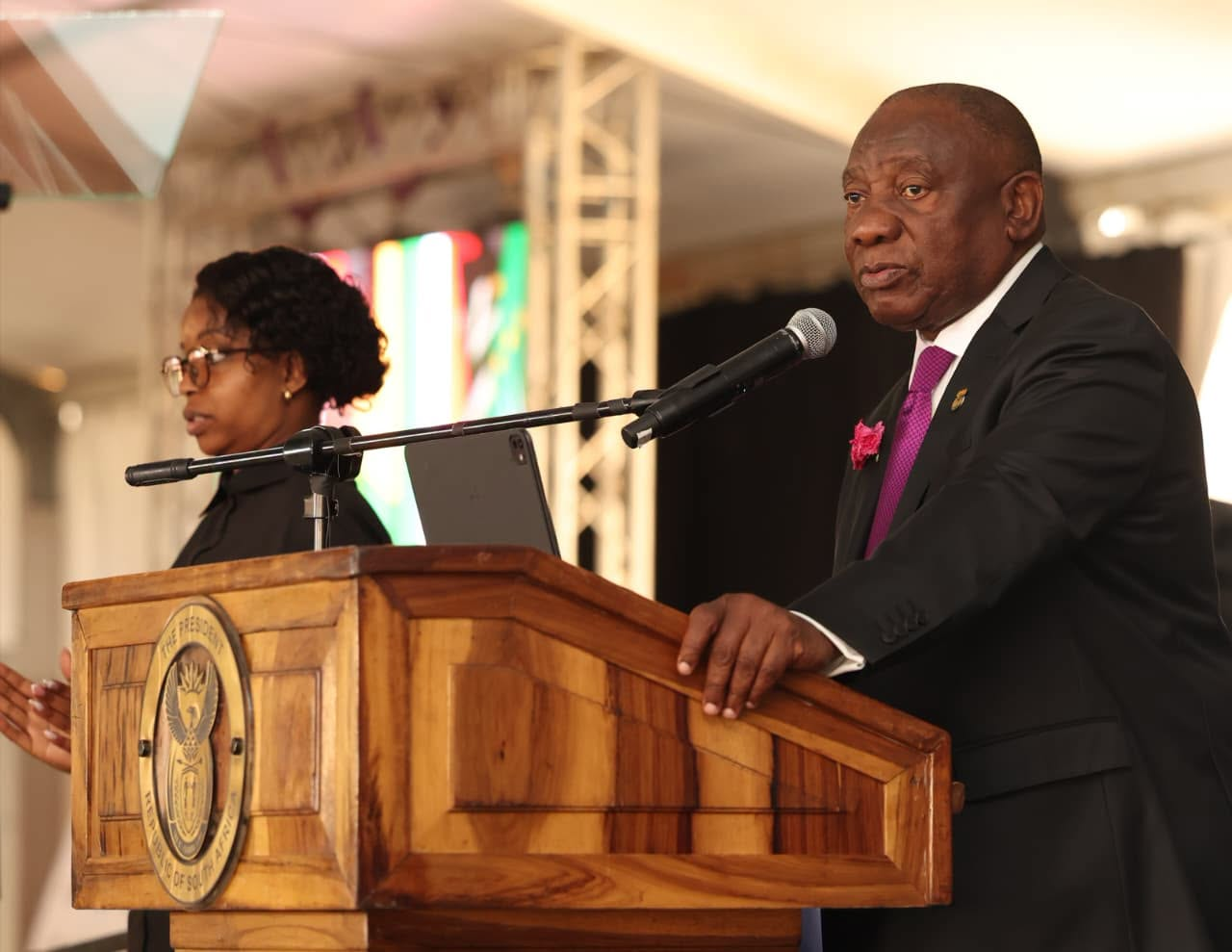
President Cyril Ramaphosa has led South Africa in commemorating the 70th anniversary of the 1956 Women’s March, describing the historic protest as one of the most important moments on the country’s national calendar.
Addressing the National Women’s Day gathering at the Union Buildings in Tshwane on Sunday, President Ramaphosa paid tribute to the more than 20 000 women who marched against apartheid pass laws on 9 August 1956.
“Today is no ordinary commemoration. National Women’s Day is a day on which we honour the women of South Africa. But it is also a day of profound significance for our entire country,” Ramaphosa said.
He said the 1956 Women’s March was far more than a moment in South Africa’s struggle against apartheid, arguing that it helped reshape the movement and demonstrated the leadership role played by women.
“The Women’s March of 1956 was not a footnote in our struggle for freedom. That helped to change the course, the character and the leadership of that struggle. It demonstrated that women were not merely supporters of the struggle. They were its leaders, its organisers and its authors,” he said.
Women of 1956 stood in silence
On 9 August 1956, thousands of women marched to the Union Buildings, then the seat of apartheid government, carrying petitions containing around 100 000 signatures opposing the pass laws.
After delivering the petitions, the women stood in silence for 30 minutes.
Ramaphosa said their silence was a powerful act of resistance.
“But theirs was not the silence of fear. It was not the silence of submission. It was the silence of courage gathering its strength,” he said.
“For thirty minutes, there was no chant, no speech and no cry. Yet their silence said everything that needed to be said. The Union Buildings may have been quiet, but the conscience of a nation was being awakened.”
The President also paid tribute to the four women who led the historic march: Lilian Ngoyi, Helen Joseph, Rahima Moosa and Sophie de Bruyn.
He stressed, however, that the four leaders represented thousands of other women whose names and stories have not yet been fully recorded.
Ramaphosa welcomed the “Write Her into History” campaign by the Ahmed Kathrada Foundation and the Sophia and Henry De Bruyn Legacy Foundation, which seeks to restore the names and stories of the women who participated in the 1956 march.
He called on families and anyone with information about the women who took part to come forward and help complete the historical record.
South Africa’s progress in empowering women
Ramaphosa said South Africa has made significant progress in advancing women's rights and representation since the advent of democracy in 1994.
Women now occupy some of the country's highest political and public offices, including positions as Ministers and Deputy Ministers, as well as Chief Justice, Speaker of the National Assembly, Chairperson of the National Council of Provinces, Public Protector and Auditor-General.
“These gains matter. They were fought for. They must be defended,” Ramaphosa said.
He said South Africa also performs strongly on international measures of women's empowerment, including gender parity, education, financial inclusion and political representation.
“We are proud of how far we have come. We are proud to stand on the shoulders of giants, of the imbokodo of 1956,” he said.
Gender-based violence remains a national crisis
Despite the progress made, Ramaphosa acknowledged that South Africa still faces major challenges, particularly gender-based violence and femicide (GBVF).
He said the government’s classification of GBVF as a national disaster was aimed at mobilising the resources and capabilities of the state to combat the crisis.
“In 1956, the women of our country lived in fear of being arrested for not having a pass. Today, women live in fear of the gender-based violence that continues to stalk them in the streets of our country, in the pathways of our villages and in their homes,” he said.
Ramaphosa stressed that GBVF is not solely a women's issue, but a societal problem that requires men and boys to play an active role in preventing violence against women.
“We need to steer men away from behaviours as well as mindsets that breed violence against women,” he said.
He also called for an end to the silence surrounding GBVF, warning that people who choose to look away can contribute to a culture that allows violence to continue.
Ramaphosa calls for a better future for women
Looking ahead, the President urged South Africans to honour the legacy of the women of 1956 by building the society they fought for.
“We commit to build a South Africa in which no woman’s potential is limited by poverty, prejudice, violence or discrimination. We will build a nation in which women are equal in law, equal in opportunity, equal in safety and equal in power,” Ramaphosa said.
“The women of South Africa have shaped our freedom, and we thank them. Together, we will shape our future.”
Meanwhile, Sophie de Bruyn, one of the four leaders of the 1956 Women’s March, called on a new generation of women to confront the modern challenges of gender-based violence, corruption and inequality.
De Bruyn reflected on the courage of the women who marched in 1956, saying they confronted the apartheid government not because they were without fear, but because they were determined to resist oppression.
“The joy of that solidarity, the triumph of knowing that we could break the back of oppression is a fire that still burns deep within me even today,” she said.
Addressing the National Women’s Day gathering at the Union Buildings in Tshwane on Sunday, President Ramaphosa paid tribute to the more than 20 000 women who marched against apartheid pass laws on 9 August 1956.
“Today is no ordinary commemoration. National Women’s Day is a day on which we honour the women of South Africa. But it is also a day of profound significance for our entire country,” Ramaphosa said.
He said the 1956 Women’s March was far more than a moment in South Africa’s struggle against apartheid, arguing that it helped reshape the movement and demonstrated the leadership role played by women.
“The Women’s March of 1956 was not a footnote in our struggle for freedom. That helped to change the course, the character and the leadership of that struggle. It demonstrated that women were not merely supporters of the struggle. They were its leaders, its organisers and its authors,” he said.
Women of 1956 stood in silence
On 9 August 1956, thousands of women marched to the Union Buildings, then the seat of apartheid government, carrying petitions containing around 100 000 signatures opposing the pass laws.
After delivering the petitions, the women stood in silence for 30 minutes.
Ramaphosa said their silence was a powerful act of resistance.
“But theirs was not the silence of fear. It was not the silence of submission. It was the silence of courage gathering its strength,” he said.
“For thirty minutes, there was no chant, no speech and no cry. Yet their silence said everything that needed to be said. The Union Buildings may have been quiet, but the conscience of a nation was being awakened.”
The President also paid tribute to the four women who led the historic march: Lilian Ngoyi, Helen Joseph, Rahima Moosa and Sophie de Bruyn.
He stressed, however, that the four leaders represented thousands of other women whose names and stories have not yet been fully recorded.
Ramaphosa welcomed the “Write Her into History” campaign by the Ahmed Kathrada Foundation and the Sophia and Henry De Bruyn Legacy Foundation, which seeks to restore the names and stories of the women who participated in the 1956 march.
He called on families and anyone with information about the women who took part to come forward and help complete the historical record.
South Africa’s progress in empowering women
Ramaphosa said South Africa has made significant progress in advancing women's rights and representation since the advent of democracy in 1994.
Women now occupy some of the country's highest political and public offices, including positions as Ministers and Deputy Ministers, as well as Chief Justice, Speaker of the National Assembly, Chairperson of the National Council of Provinces, Public Protector and Auditor-General.
“These gains matter. They were fought for. They must be defended,” Ramaphosa said.
He said South Africa also performs strongly on international measures of women's empowerment, including gender parity, education, financial inclusion and political representation.
“We are proud of how far we have come. We are proud to stand on the shoulders of giants, of the imbokodo of 1956,” he said.
Gender-based violence remains a national crisis
Despite the progress made, Ramaphosa acknowledged that South Africa still faces major challenges, particularly gender-based violence and femicide (GBVF).
He said the government’s classification of GBVF as a national disaster was aimed at mobilising the resources and capabilities of the state to combat the crisis.
“In 1956, the women of our country lived in fear of being arrested for not having a pass. Today, women live in fear of the gender-based violence that continues to stalk them in the streets of our country, in the pathways of our villages and in their homes,” he said.
Ramaphosa stressed that GBVF is not solely a women's issue, but a societal problem that requires men and boys to play an active role in preventing violence against women.
“We need to steer men away from behaviours as well as mindsets that breed violence against women,” he said.
He also called for an end to the silence surrounding GBVF, warning that people who choose to look away can contribute to a culture that allows violence to continue.
Ramaphosa calls for a better future for women
Looking ahead, the President urged South Africans to honour the legacy of the women of 1956 by building the society they fought for.
“We commit to build a South Africa in which no woman’s potential is limited by poverty, prejudice, violence or discrimination. We will build a nation in which women are equal in law, equal in opportunity, equal in safety and equal in power,” Ramaphosa said.
“The women of South Africa have shaped our freedom, and we thank them. Together, we will shape our future.”
Meanwhile, Sophie de Bruyn, one of the four leaders of the 1956 Women’s March, called on a new generation of women to confront the modern challenges of gender-based violence, corruption and inequality.
De Bruyn reflected on the courage of the women who marched in 1956, saying they confronted the apartheid government not because they were without fear, but because they were determined to resist oppression.
“The joy of that solidarity, the triumph of knowing that we could break the back of oppression is a fire that still burns deep within me even today,” she said.