Southern Africa’s highest weather station to boost research

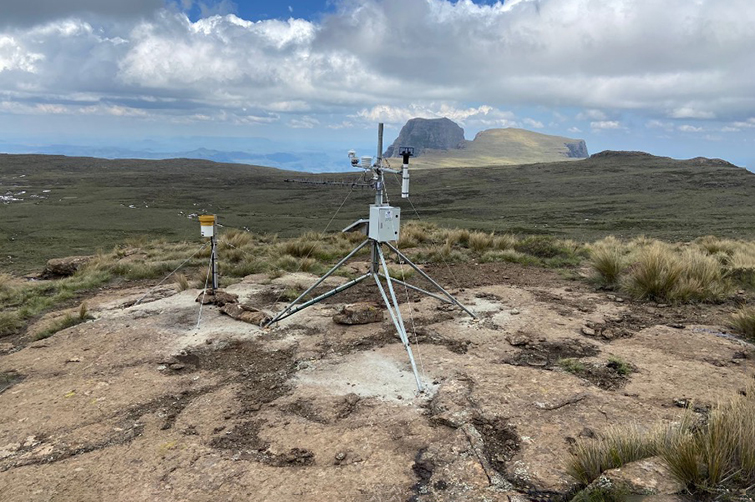
The South African Environmental Observation Network (SAEON), in collaboration with the Afromontane Research Unit (ARU) at the University of the Free State, has installed the highest weather station in Southern Africa, located in the Mont-aux-Sources area of the Maluti-Drakensberg.

Positioned atop the iconic amphitheatre at 3 100 metres above sea level, the automatic weather station will provide real-time climate data critical to understanding a region of exceptional biodiversity value. 

The site encompasses key alpine and high-altitude ecosystems of the Drakensberg, which makes continuous environmental monitoring essential for research and conservation.

This strategically located station forms part of a growing network of advanced research infrastructure being deployed across the Northern Drakensberg. 

The initiative is jointly implemented through SAEON’s Expanded Freshwater and Terrestrial Environmental Observation Network (EFTEON), the SAEON Grasslands Node, and the ARU.

The station records temperature, humidity, wind, incoming solar radiation, rainfall, and barometric pressure.

“These continuous measurements are essential for tracking climate change, extreme weather, and catchment health in real time,” said biogeochemist and manager of EFTEON Northern Drakensberg, Dr Kathleen Smart. 

“The information will be openly available to researchers, land managers, hikers, tourism operators, and anybody interested in the dynamics of this truly remarkable landscape.”

Director of the ARU, Professor Ralph Clark, said this station represents years of collaboration between SAEON and the ARU. 

“It opens a window into the environmental processes that shape mountain ecosystems, which are vital for water security and biodiversity.”

The new station is one of five positioned along an altitudinal gradient stretching from the University of the Free State’s Qwaqwa Campus, through Witsieshoek Mountain Lodge, to the alpine zone atop the Maloti-Drakensberg escarpment. 

It enhances the existing programmes and research initiatives currently in progress within the Mount-Aux-Sources Long-Term Socio-Ecological Research Platform (MaS-LTSER), which is the only cross-border, mountain-focused LTSER platform in Africa.

Streamflow and wetland water content are monitored continuously within this open-air laboratory, which also boasts the highest research accommodation facility in Africa.

Professor Johan van Tol, who leads the MaS-LTSER initiative, stated that Abri de Buys, the Chief Instrument Technician for EFTEON, and Jeremy Moonsamy, EFTEON’s Instrument Technician for the Northern Drakensberg, oversaw the installation of the weather station.

“This region is critical for several reasons. It supports the livelihoods of many people in the Free State, KwaZulu-Natal, and Lesotho, many of whom depend heavily on the availability and quality of ecosystem services derived from these mountainous landscapes. At a national scale, this includes areas of agricultural importance,” said Van Tol.

Moonsamy stated that this area is a strategic water source and the origin of several major rivers in South Africa, including the Orange, Tugela, and Vaal systems.

“It is, therefore, vital to monitor and understand the conditions and processes driving change in this region, including issues such as climate change, land use and land management impacts, and atmospheric pollution.”

De Buys noted that most of the weather networks in South Africa are situated in lower-lying areas where human activity is prevalent.

He highlighted that there is a lack of information from the high mountainous regions, which is the area that SAEON is gradually beginning to explore.

SAEON was established in 2002 as a unit within the National Research Foundation (NRF) dedicated to research on environmental change.

Live measurements will be available on the SAEON live weather platform, where downloadable datasets will also be hosted here 

Newly trained officers to help ensure a safer festive season

Lieutenant General Tebello Mosikili of the South African Police Service on Friday assured South Africans that with an additional 3 558 newly trained police officers on the ground,  SAPS will be working hard to ensure everyone is safe during the festive season.

“We have indeed entered a period of heightened police operations to ensure that people are and feel safe this festive season,” she said.

Acting Police Minister, Prof Firoz Cachalia, last Friday welcomed the newly-qualified police constables who have completed their training at various SAPS academies in the country.

The SAPS has been actively deploying new constables to enhance crime-fighting capabilities and improve public safety. Some of the new constables were deployed at the Nasrec Expo Centre where the G20 Leaders’ Summit took place last weekend.

“It’s all hands on deck as the men and women in blue - working closely with other law enforcement agencies - continue to stamp the authority of the state in every corner of our country,” Mosikili said.

She was speaking at the release of Quarter 1 and 2 crime statistics in Pretoria, which she painted a picture of a relentless fight to keep people safe.

“We are not where we want to be in terms of the numbers. We would surely like to see a further reduction of cases reported and detected as well as a lot more green graphs indicating a downward trend.

“Let’s all agree, that we are going somewhere, and we are feeling the difference through our weekly integrated multidisciplinary operations commonly known as Operation Shanela,” Mosikili said.

She said it was encouraging to note that between the first and second quarter which is the period covering 1 April up until 31 September 2025, 413 583 suspects were arrested.

“During the same period, 3 442 firearms were seized during the operations. As we are all aware, alcohol remains one of the driving factors behind a lot of contact crimes. It is worth noting that police closed and shut down 11 975 unlicensed liquor premises.”

Mosikili said throughout the country, in every province, criminals were feeling the full might of the law and that they did not have anywhere to hide.

“From the Western Cape to KwaZulu Natal and where we are today in Gauteng, police remain resolute and there is no turning back.

“In the Western Cape, where we have ongoing gang violence, 722 gangsters were arrested with 1565 illegal firearms and more than 39 000 rounds of ammunition seized during the operations.

“In KwaZulu-Natal, five accused persons behind the Umlazi Glebelands hostel mass shooting in June 2023 where eight people died were each handed down eight life sentences and an additional 15 years in jail to each of the five accused,” she said.

Eskom ready for Summer: Power system remains stable, resilient

Eskom says the country’s power system remains stable, with unplanned outages reduced by 763MW year-on-year and a continued decline in diesel usage.

“South Africa’s power system remains stable and resilient, reliably meeting the country’s electricity demand. This performance reflects long-term structural improvements in the generation fleet and the ongoing implementation of the Generation Recovery Plan, which is strengthening operations and securing the nation’s energy future,” said the power utility in a statement.

It said the Energy Availability Factor (EAF) - which measures the percentage of time the generation fleet is available to produce electricity - stands at 68.48% month-to-date, a notable increase of 6.24% from 62.24% in the same period last year.

“Year-to-date, the EAF further increased to 63.65%, with the fleet achieving or exceeding the 70% mark on 39 occasions. These figures underscore both recovery and sustained improvement in the EAF performance, reinforcing energy security and grid stability.

“The continued improvement in the EAF has significantly reduced Eskom’s reliance on costly diesel generation, allowing the company to focus more on cost-effective primary energy sources.”

Additionally, six generation units, equivalent to 2 341MW, are currently on cold reserve due to excess capacity.

“Last week’s diesel expenditure amounted to just R105.5 million. This minimal usage was primarily directed at protecting and replenishing our emergency reserves, highlighting both the financial and operational gains achieved through Eskom’s turnaround,” the utility said.

For the period 21 to 27 November 2025, the average Unplanned Capacity Loss Factor (UCLF) - which measures the percentage of generation capacity lost due to unplanned outages - is at 20.34%, a significant reduction of 1.16% from 21.50% during the same period last year.

The average Planned Capacity Loss Factor (PCLF) for 21 to 27 November 2025 increased to 14.52%, lower than the 17.60% recorded last year. This planned maintenance aligns with Eskom’s maintenance schedule and ongoing efforts to enhance plant reliability and operational consistency.

Between 21 and 27 November 2025, Eskom recorded an average of 9 711MW in unplanned outages, an improvement from 10 474MW during the same period last year. 

This year-on-year reduction of 763MW in breakdowns highlights the growing reliability and resilience of the generation fleet.

South Africa has now experienced 196 consecutive days without an interrupted supply, with only 26 hours of loadshedding recorded in April and May during this financial year.

To maintain a stable electricity supply, Eskom will bring 3 875MW of generation capacity online ahead of the evening peak on Monday, 1 December 2025.

Eskom published the Summer Outlook on 5 September 2025, covering the period 1 September 2025 to 31 March 2026, which projects no loadshedding due to sustained improvements in plant performance from the Generation Recovery Plan.

“The power system remains stable, with generation capacity exceeding demand. However, adverse weather is impacting distribution networks, creating access challenges and delaying repairs in certain areas, particularly in Gauteng.

“In addition, illegal connections and meter tampering continue to damage infrastructure and pose serious safety risks. Load reduction remains a temporary measure in high-risk areas to protect both communities and the power network.”

Any illegal activity affecting Eskom’s infrastructure can be reported to the Eskom Crime Line at 0800 112 722 or via WhatsApp at 081 333 3323. 

Matrics urged to celebrate safely

The matric exam session has officially wrapped up, and many learners will attend formal matric 'rage' events and smaller “pens-down” celebrations over the next week. While it’s natural for matrics to want to mark the end of their school careers, authorities are urging them to do so responsibly.

Learners are encouraged to familiarise themselves with safety measures at events, keep emergency numbers handy, and remain alert to their surroundings. They are also advised to watch their valuables closely, avoid leaving drinks unattended, report any suspicious activity to police or organisers, and avoid drinking and driving. Setting up a buddy system and staying in regular contact with parents is strongly recommended.

Parents are urged to ensure their children understand the risks involved in year-end celebrations and to make arrangements to stay in contact and know what to do in an emergency.

Authorities warn that one bad decision can have lifelong consequences and are calling on matrics to put their futures first and celebrate safely.

Latest Crime Stats released

South Africa has released the first-quarter crime statistics for April to June 2025. The latest figures show persistently high levels of contact crime, with murder, rape and aggravated robbery remaining key contributors.

More than 5 400 murders were recorded in the three-month period. Police data shows many killings were linked to arguments, vigilantism, retaliation and alcohol-related incidents. Most murders occurred in public spaces and at private residences, with knives and firearms frequently used. Several police officers were killed on and off duty, and attacks on rural communities and farm-related incidents were also reported.

Rape cases exceeded 6 500, with most attacks taking place at private residences or locations known to the victims. Some cases occurred at educational facilities, involving both adults and minors.

Attempted murder and assault with intent to cause grievous bodily harm remain high, with more than 31 000 assault GBH cases analysed. Alcohol and drug-related environments, including taverns and bars, were identified as major crime scenes.

Aggravated robberies continue to rise. Carjackings increased, with more than 4 600 incidents recorded.

Residential and business robberies also remain high, with several provinces contributing heavily to the national total. Cash-in-transit robberies showed varied methods, including attacks during ATM replenishments, cross-pavement robberies and armed threats against security personnel. Truck hijackings remain a concern, with hotspots concentrated at top contributing stations across multiple provinces.

The report highlights 17 community-reported serious crimes, showing fluctuations across the quarter and identifying the 30 police stations with the highest contributions. Provincial data shows varying crime ratios per 100 000 population, with some provinces recording significantly higher levels of violent crime.

Domestic-violence-related offences remain widespread, affecting both men and women across all provinces.

SAPS says the full quarterly crime presentation and detailed statistics are available on its official website.

Public urged to avoid Cape fur seals over holiday season

The public is urged to exercise caution and follow safety guidelines during the upcoming summer holiday season when encountering Cape fur seals. While these marine mammals form an integral part of our coastal ecosystem, it is crucial to recognise that human-wildlife interactions can have severe consequences.

Recently, reports of aggression related to positive rabies cases have been noted in Cape fur seal populations. Seals may also carry other diseases that can be transmitted to humans and have sharp teeth that can cause physical damage.

It should be noted that activities that disturb seals in general are illegal without a permit, according to the NEMBA (National Environmental Management: Biodiversity Act) TOPS (Threatened or Protected Species) regulations. These activities include petting, as it disturbs the animal’s natural behaviour and exposes humans to potential dangers such as bites, scratches, infections and disease.

Even in instances where a seal pup is found on a beach, people should avoid interacting with the animal. The public should contact the authorities who are trained and equipped to rescue and care for such animals.

While it is common for seals to haul out on beaches to rest, it is important to recognise any signs of distress or abnormal behaviour when encountering a seal. Seals may display defensive behaviour if they feel threatened or are injured. They may display aggressive or disoriented behaviour if infected by rabies.

Rabies can be transmitted through bites, scratches or direct contact with saliva and is fatal for both humans and unvaccinated animals.

The public is urged to stay away from seals and not to touch or engage with them. Swimmers and surfers must be extra vigilant while in the sea. If a seal is spotted, exit the water immediately and if you suspect it may have rabies, report it to the lifeguards or Municipal Authorities.

"As we approach the busy summer season, I remind everyone that Cape fur seals are wild animals. Even well-intentioned interactions can have serious consequences for both people and the animals. We urge the public to act responsibly, avoid contact, and immediately report any abnormal or aggressive seal behaviour to the authorities," said Dr Ashley Naidoo, CEO of CapeNature.

In case of a seal bite/scratch/lick:

-If a seal bites/scratches someone in the water, the beach will be closed immediately, marked by the activation of a shark siren and the raising of a shark flag, if available.
-Shark spotters or lifeguards will promptly notify CapeNature and the State Veterinarian, who will provide guidance on the necessary action. Municipal Disaster Management and appropriate Marine Stranding Networks will also be informed.
-Lifeguards or first responders will monitor and track the seal's movements.
-The beach will only reopen after the seal has been safely removed or has vacated the area.
-Anyone bitten, scratched or licked by a suspect rabid seal should seek urgent medical care at the nearest hospital. At the scene, the wound must be thoroughly washed with soap and water for 10-15 minutes.
-The person must then be taken to the nearest hospital to receive post-exposure prophylactic treatment against rabies. The patient needs to inform the hospital personnel that the bite/scratch/lick is from a seal that may be rabid.
-A video of the seal's behaviour should be captured if possible and sent to CapeNature at 083 236 2924, including a location pin. This will be placed on the appropriate stranding network for advice and planned reaction.
-If your pet has been bitten or scratched by a seal, consult the local state veterinarian. Provide details of the incident, including wound type, treatment received, and vaccination history. Follow the same wound-cleaning protocol for pets as for humans. Ensure your pets are vaccinated against rabies as this is the only means to protect them against this deadly disease. It is a legal requirement for all dogs and cats in South Africa to be vaccinated against rabies.

Contact details for Provincial Veterinary Services are available here.

Ramaphosa notes US statement on South Africa’s G20 participation

President Cyril Ramaphosa has responded to what he described as a “regrettable” statement by US President Donald Trump regarding South Africa’s participation in the 2026 G20 meetings.

The Presidency said the 2025 G20 Leaders Summit in Johannesburg - attended by several heads of state and government - was widely regarded as one of the most successful gatherings of the forum. The summit concluded with a declaration underscoring the importance of multilateralism in addressing global challenges. Because the United States did not attend the summit, South Africa formally handed over the G20 Presidency instruments to a representative of the US Embassy at the Department of International Relations and Cooperation in Pretoria.

As a founding member of the G20, South Africa said it has always upheld the forum’s principles of consensus, collaboration and partnership. Ramaphosa noted that the US was expected to participate fully in all G20 meetings during South Africa’s presidency but chose not to attend the leaders’ summit “of its own volition”.

Despite Washington’s absence, South Africa welcomed the strong participation of US businesses and civil society organisations in related events, including the B20 and G20 Social.

The Presidency emphasised that South Africa’s membership of the G20 is recognised by all member states and grounded in its status as a sovereign democratic nation. It added that South Africa “does not appreciate insults from another country” regarding its legitimacy on the global stage and stressed that it would never demean the sovereignty or standing of another nation.

South Africa will continue to serve as a full and constructive G20 member and called on all partners to uphold the group’s multilateral spirit, consensus-based decision-making, and equal participation.

The Presidency also expressed disappointment that, despite efforts to reset relations with Washington, Trump “continues to apply punitive measures” against South Africa based on what it described as “misinformation and distortions” about the country.

W Cape issues alert as drunk driving arrests rise

Western Cape transport officials have issued a serious warning to motorists after 24 arrests for driving under the influence of alcohol were made in just one week.

From 17 to 23 November 2025, the Provincial Traffic Services carried out 168 integrated roadblocks, vehicle checks, and speed control operations across the province.
 
During these efforts, over 30 000 vehicles were stopped and inspected, resulting in more than 9 000 fines being issued for various violations related to driver and vehicle fitness.

Officers also recorded 200 speeding offences during this period.

The officials reported that of the 46 arrests recorded, 24 were for driving under the influence of alcohol, three for reckless and negligent driving, six for goods overloading and another six for possession of fraudulent documentation. 

In addition, three arrests involved undocumented persons, while one person was arrested for wilfully damaging or tampering with a vehicle or throwing an object at a vehicle. 

One person was arrested for bribery, another for obstructing or hindering an authorised officer, and one for threatening or suggesting the use of violence against a traffic officer.

Western Cape Mobility MEC Isaac Sileku expressed deep concern at the spike in drunk driving incidents.

“Every driver who gets behind the wheel after drinking is a danger not only to themselves, but to every person on the road. As we approach the festive season, we are intensifying enforcement to ensure that law-abiding road users can travel safely. Driving under the influence will not be tolerated, and we will continue to take decisive action against offenders,” said Sileku.

Chief Director of Traffic Management Maxine Bezuidenhout urged the public to take responsibility. 
“The high number of drunk driving arrests is deeply concerning. Even small amounts of alcohol can impair judgement and slow reaction times. Our officers will continue to take firm action against anyone who chooses to endanger others by driving under the influence. We urge motorists to act responsibly, respect the law, and help us prevent unnecessary incidents and loss of life on our roads,” said Bezuidenhout.

To prevent drinking and driving, motorists are encouraged to plan ahead by using e-hailing services or metered taxis, appointing a sober designated driver, arranging to stay over where they are socialising, or asking a friend or family member for a lift. 

They are also urged to refuse to travel in a vehicle with a driver who has been drinking.
“Road safety is everyone’s responsibility,” Sileku added.

Government proposes 20% online gambling tax

National Treasury has encouraged the public to submit comments on a draft national online gambling tax discussion paper. 

Due to the surge in online gambling and its impact on society, it is proposed that a 20% tax is applied on gross gambling revenue from online betting, including interactive gambling, which would be in addition to the currently applied provincial taxes.

“The discussion paper provides an overview of the gambling industry in the country, considers the current legislative framework and international practices on the taxation of online gambling and proposes a new national online gambling tax for South Africa,” National Treasury said.

Over the years, the gambling industry has evolved from traditional forms of gambling to the greater use of online gambling. 

This has been influenced by technological advancements and increased access to the internet and electronic communication tools, especially following the COVID-19 pandemic. Gambling is now easily available online and it is accessible almost anywhere and at any time.

“The growth of online gambling also brings challenges, such as problem gambling and social issues, which require continued monitoring and responsive regulation. 

“From a public policy perspective, there should be no problem with recreational gamblers as they do not place any external costs on society. 

“However, to the extent that problem gambling imposes a cost on society (negative externalities), it is in the public interest that such behaviour be regulated or reduced,” National Treasury said.

The draft national online gambling tax discussion paper has been released for public comments and is available on the National Treasury website: www.treasury.gov.za. 

The public can forward written comments to the email address: [email protected] by close of business on 30 January 2026.

Eskom turns the corner

Global ratings agency, S&P, has upgraded Eskom’s foreign and local currency long-term credit ratings from B to B+, with a stable outlook.

According to the power utility, the upgrade also applies to Eskom’s senior secured and unsecured debt, while government-guaranteed foreign currency debt was raised from BB- to BB+.

“Eskom’s national scale rating improved from zaBBB+/zaA-2 to zaAV/zaA-1. The upgrade reflects the measurable impact of Eskom’s Turnaround Plan, which has stabilised generation, improved financial performance and strengthened governance. Operational improvements have been substantial: Eskom delivered electricity 97.9% of the time in the current financial year, compared to 96% in FY2025.

“This operational stability has been matched by strong financial performance, which includes our first profitability in eight years in FY2025,” the power utility said.

Eskom Group Chief Executive, Dan Marokane, reflected on the company’s turnaround.

“The turnaround plan has been pivotal in restoring Eskom’s operational and financial stability.

“We have moved decisively from a generation crisis to a phase of reliability and disciplined management. Our focus remains on providing affordable, secure electricity for South Africa while driving the transition to lower-carbon energy,” Marokane said.
error: eRadio is protected !
Scroll to Top