Transnet records R4.6 billion profit

Transnet has reported a R4.6 billion profit for the financial year ended 31 March 2026, reversing a R1.9 billion loss recorded the previous year.

Revenue increased by 7.1% to R88.6 billion, supported by higher rail and pipeline volumes and tariff increases.

Rail volumes rose 4.9% to 167.9 million tonnes, while EBITDA increased slightly to R30.9 billion. Operating expenses, however, rose by 10.8% to R57.7 billion.

Transnet says improved rail reliability, maintenance and asset availability contributed to the recovery, although challenges remain.

A major development was the sale of a 49.999% stake in Durban Gateway Terminal to International Container Terminal Services for R10.5 billion. The transaction generated a R12.5 billion profit and transferred management control to ICTSI, while Transnet retains a 50.001% stake.

The company invested R23.3 billion in infrastructure and equipment during the year. National Treasury has also approved R14.8 billion in grant funding for strategic rail and port projects.

Transnet says further progress has been made on freight logistics reforms, including opening the rail network to private operators.

Agreements have been signed with 11 train operating companies, with the first expected to begin services during the 2026/27 financial year.

The company says its focus remains on improving reliability, increasing freight volumes, attracting private investment and strengthening its long-term financial sustainability.
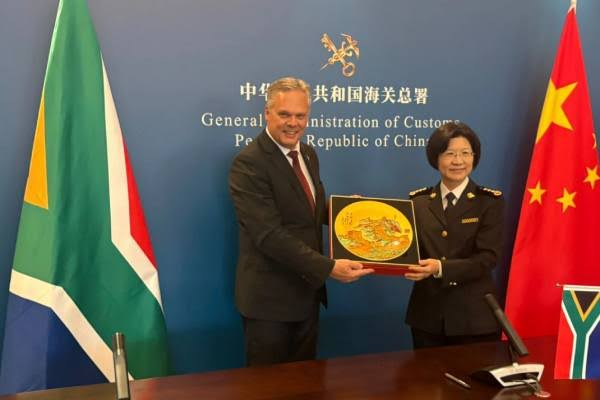

South African cherries gain access to Chinese market

South African cherry producers have gained access to the lucrative Chinese market following the signing of a new market access protocol between the two countries.

Agriculture Minister Wille Aucamp signed the landmark agreement with General Administration of Chinese Customs (GACC) Minister Sun Meijun during the ninth Sanitary and Phytosanitary (SPS) Ministerial Meeting in Beijing.

Aucamp described the agreement as a significant achievement, noting that it marks the first time South Africa and China have signed two agricultural market access protocols within a single year.

“We truly appreciate China’s efforts to speed up our market access requests for South African agriculture products,” Aucamp said.

The minister said the agreement reinforces the strong agricultural partnership between South Africa and China and supports efforts to expand bilateral trade.

The cherry protocol also aligns with commitments made under the Framework Agreement on Economic Partnership for Shared Development, which provides South African agricultural products with 0% tariff access to the Chinese market.

The agreement could deliver significant economic benefits, with China the world’s largest cherry importer. The country imported about 586 900 tonnes of cherries in 2025, valued at approximately US$3.3 billion (R52.8 billion).

More agricultural cooperation

Aucamp also met with China’s Minister of Agriculture and Rural Affairs, Zhang Zhu, where the two ministers reaffirmed their commitment to cooperation in areas including biosecurity, particularly Foot and Mouth Disease, as well as expanding market access for South African agricultural products.

He also met representatives of Chinese fruit importers during the South Africa-China Fruit Trade Business Forum, organised by FruitSA.

According to Aucamp, access to the Chinese market is expected to encourage further investment in South Africa’s cherry industry and create around 600 new jobs.

“There is more to come between South Africa and China now that the negotiations to grant market access for South African blueberries to China are at an advanced stage,” he said.

China has already submitted a draft protocol for the import of South African blueberries. Aucamp has instructed Team South Africa to fast-track consultations and negotiations, with the aim of finalising the agreement before the end of the year.

South Africa’s economy contracts by 0.2% in Q2 2026

South Africa’s economy contracted by 0.2% in the second quarter of 2026, a sharp reversal from the 0.4% growth recorded during the first quarter.

The figures were released by Statistics South Africa (Stats SA) on Tuesday.

The contraction was largely driven by declines in the trade, catering and accommodation sector, which fell by 1.9% and shaved 0.2 of a percentage point off GDP growth.

Stats SA said lower activity was recorded in wholesale and motor trade, as well as food and beverage services.

Manufacturing also declined, falling by 1.8% and contributing a negative 0.2 of a percentage point. Seven of the sector’s 10 divisions recorded negative growth.

The biggest declines were recorded in food and beverages, furniture and other manufacturing, as well as basic iron and steel, non-ferrous metals, metal products and machinery.

Mining and quarrying contracted by 3.0%, reducing GDP growth by a further 0.1 of a percentage point. The main contributors to the decline were platinum group metals, manganese ore, gold and iron ore.

Some sectors recorded modest growth during the quarter.

Finance, real estate and business services increased by 0.3%, adding 0.1 of a percentage point to GDP. Financial intermediation, insurance and pension funding, and other business services were among the main contributors.

Transport, storage and communication grew by 0.9%, also adding 0.1 of a percentage point, with land transport recording increased activity.

General government services rose by 1.0%, contributing another 0.1 of a percentage point, largely due to higher employee compensation at extra-budgetary and higher education institutions, as well as provincial government.

Personal services increased by 0.6%, supported by stronger activity in community services and other producers.

Household spending also edged higher, with household final consumption expenditure increasing by 0.4%. Stats SA said this contributed 0.3 of a percentage point to overall GDP growth.

Spending on food and non-alcoholic beverages rose by 1.2%, while expenditure on other goods and services increased by 0.6%. Recreation and culture rose by 0.8%, while health spending increased by 0.7%.

These gains were partly offset by lower household spending on housing, water, electricity, gas and other fuels, as well as transport, communication, clothing and footwear.

DStv set for major package shake-up from 17 September

DStv is making its biggest overhaul of its package structure in around 15 years, with a new line-up of options set to launch in South Africa on 17 September.

The changes are designed to give customers more choice over what they pay for, with sport and entertainment being separated into more clearly defined packages.

The current Access, Family and Compact packages will make way for Starter, Select and Sports, while a new Movies & Series package will sit below Premium.

Starter – R150 on satellite, R99 on DStv Stream

Starter replaces Access and is aimed at viewers looking for a more affordable entry point to DStv.

The package adds channels including Wethu+, kykNET & Kie and SuperSport KICKOFF, while retaining a selection of entertainment and sports content.

Wethu+ will combine local movies, music, stories and selected football content.

Select – R339 on satellite, R299 on DStv Stream

Select replaces Family and brings more popular entertainment and sport to the lower end of the DStv line-up.

It includes Mzansi Magic, every PSL match and DStv's children's channels, making it particularly attractive to households looking for local entertainment and football without paying for a higher package.

Sports – R479 on satellite, R399 on DStv Stream

One of the biggest changes is the introduction of DStv Sports.

The package is based on the current Compact offering but significantly increases access to live sport.

Subscribers will get every Premier League and UEFA Champions League match, all cricket, local rugby, one URC match per week, UFC and other sporting content.

Sports subscribers will also receive the entertainment included in Select, meaning it is not a sports-only package.

However, some of the most premium sporting rights will remain exclusive to Premium. These include Springbok and other international rugby, Formula 1, MotoGP, major golf and tennis.

Movies & Series – R500

DStv is also introducing a completely new entertainment-focused package.

Movies & Series will include M-Net, kykNET, M-Net Movies+ and other entertainment channels, as well as Discovery Channel and BBC Earth.

It also includes a selection of sports channels.

Importantly, this marks the first time since DStv launched in 1995 that M-Net will be available below the Premium tier.
Premium remains at the top

DStv Premium is staying largely unchanged.

It will continue to provide the most comprehensive combination of entertainment and sport, including the premium sporting rights that are being kept out of the new Sports package.

The streaming price remains R799 per month, while satellite Premium remains R979.

Customers who commit to a 24-month Premium contract can also access Premium for R799 a month on satellite.

What happens to existing subscribers?

DStv says existing Access, Family and Compact subscribers will automatically move to the corresponding new packages during September.

That means:
Access → Starter
Family → Select
Compact → Sports

Compact Plus is being treated differently. Its subscribers will be moved to Premium and protected at their existing price for 12 months before they will have to decide whether to remain on Premium or select another package.

Premium subscribers will remain on Premium.

More channels are also coming

Two new channels will join the DStv platform from 17 September.

These are France 24, the international news channel, and Church TV, a faith-based channel.

The package overhaul comes as DStv faces increasing competition from streaming services and changing viewing habits, with households becoming more selective about the content they are prepared to pay for.

For DStv, the strategy is straightforward: rather than forcing customers into an expensive package to access one particular type of content, the company is giving viewers more specialised options.

The big question now is whether customers will see the new structure as better value - and whether it can help DStv attract and retain subscribers in an increasingly competitive streaming market.

The new packages officially take effect on 17 September 2026.
error:
Scroll to Top