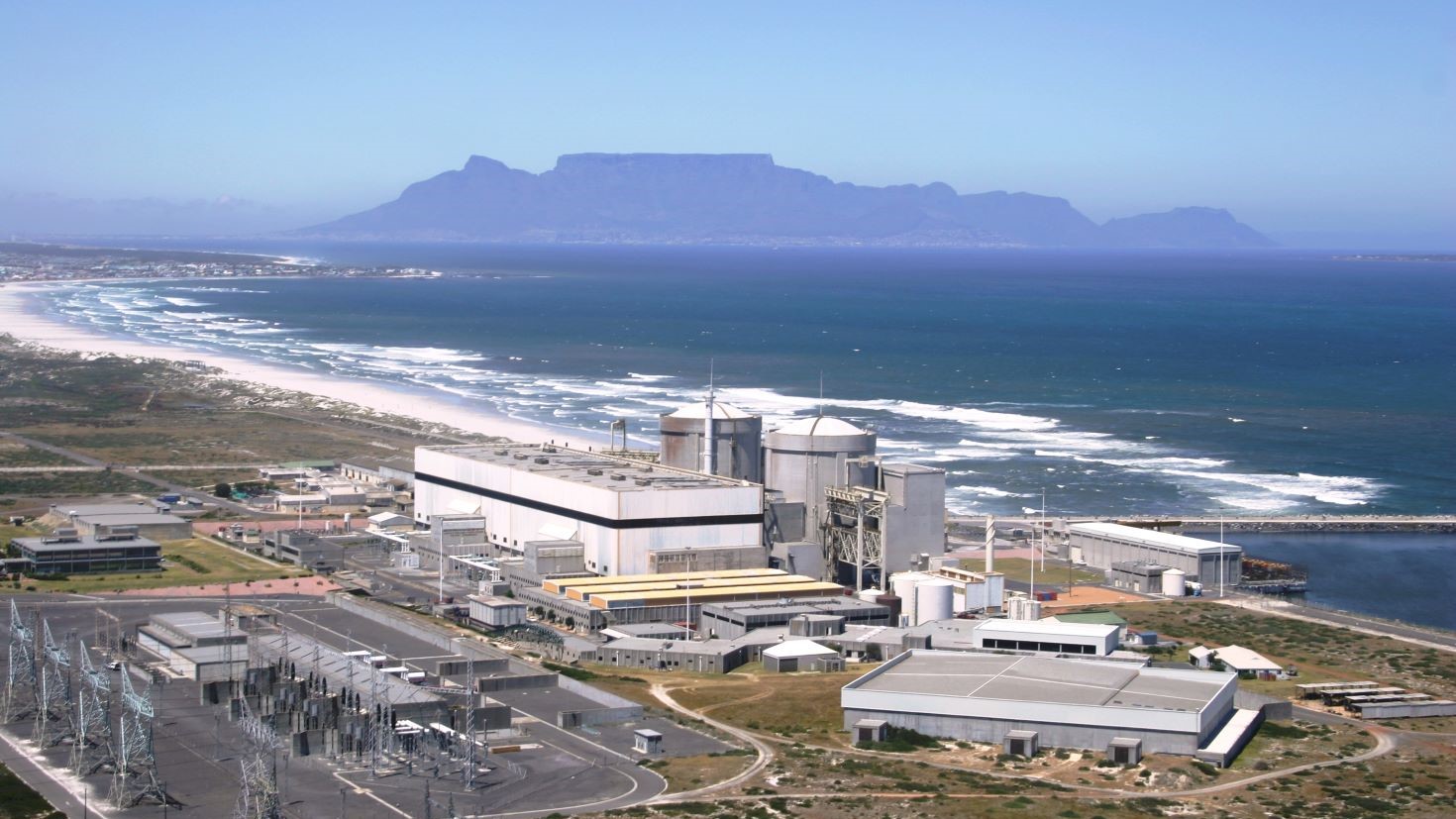
Koeberg Unit 1 Taken Offline After Turbine Trip, Grid Remains Stable

Koeberg Nuclear Power Station’s Unit 1 was safely taken offline shortly before 1am on Thursday following a turbine trip, with Eskom confirming that nuclear safety was never compromised.

According to Eskom, the unit was shut down in line with established safety procedures, while plant monitoring systems confirmed that operating conditions remained stable throughout the incident.

The utility said there was no risk to employees, the public or the environment, and that Koeberg’s protection and monitoring systems operated as designed to ensure the plant remained safe.

Eskom also assured South Africans that the loss of Unit 1’s generating capacity would not affect the stability of the national electricity grid.

The utility said it has sufficient generation capacity available and that the electricity supply remains stable and secure.

Unit 1 was last taken offline for major maintenance, which was completed in October 2025. Since returning to service, the unit has operated reliably.

Generation was temporarily reduced earlier this month as a precaution following seawater intake challenges linked to a sardine influx near the station’s cooling water system.

The sardine influx coincided with reports of increased sardine mortality along the South-Western and West Coast. An inter-agency investigation led by the Department of Forestry, Fisheries and the Environment is continuing, with no evidence at this stage linking the incidents to Koeberg’s operations.

The cause of Thursday’s turbine trip is now under investigation. Eskom said it would provide further updates as more information becomes available.
Eskom reports 441 days without load shedding

South Africa has reached 441 consecutive days without load shedding, with Eskom reporting significant improvements in power generation, lower unplanned outages and dramatically reduced diesel usage.

According to the power utility, the country has remained free of load shedding since 16 May 2025. Between 1 April and 30 July 2026, electricity demand was met 100% of the time, while Eskom's Winter Outlook continues to indicate that no load shedding is expected until at least 31 August 2026.

Eskom records highest energy availability since 2017

Eskom said the sustained improvement is the result of its ongoing Generation Recovery Plan, which has boosted generation capacity and strengthened the reliability of the national grid.

A major milestone was achieved on 26 July 2026, when the utility recorded a daily Energy Availability Factor (EAF) of 82.04% — the highest daily performance since 2017.

The financial year-to-date EAF has increased to 66.97%, representing a 7.28% improvement compared with the same period last year and an 11.8% improvement over three years. This has restored approximately 5.9GW of generating capacity to the national grid.

Eskom added that more than 85% of its coal-fired power stations are currently operating at EAF levels between 73% and 97%.
Unplanned outages nearly halved

The utility also reported a significant decline in unplanned breakdowns.

On 26 July, unplanned outages dropped to 4,562MW - the lowest level since 30 June 2018, when outages stood at 4,327MW.
During the week of 24 to 30 July, average unplanned outages measured 5,553MW, down from 10,641MW during the same period in 2025. This represents a reduction of 5,088MW, or 47.8% year-on-year.

The Unplanned Capacity Loss Factor (UCLF) improved to 11.74%, compared with 22.21% a year earlier, while planned maintenance averaged 8.94%, down from 10.40% over the same period.
Diesel spending slashed by more than 85%

Improved plant performance has significantly reduced Eskom's dependence on expensive diesel-fired generation.

The utility confirmed that no diesel was used between 24 and 30 July, marking the second consecutive week without diesel consumption.

From 1 April to 30 July 2026, diesel expenditure totalled R807.41 million, compared with R5.63 billion during the same period last year - an 85.67% reduction.

Open-Cycle Gas Turbines (OCGTs), which are typically used during periods of high electricity demand, operated at an average load factor of just 1.08%, down from 9.71% a year earlier.

Year-to-date OCGT generation reached 105.977GWh, approximately 88.89% lower than the corresponding period in 2025.
Load reduction programme continues despite end of load shedding

Although nationwide load shedding has ended, Eskom continues implementing load reduction in selected communities affected by illegal electricity connections, meter tampering, overloaded networks and infrastructure damage.

The utility's Load Reduction Eradication Programme has removed approximately 1.196 million customers from load reduction schedules, representing 70.8% of the 1.69 million customers originally affected.

Six of South Africa's nine provinces have now been completely removed from load reduction, while work continues in Gauteng, KwaZulu-Natal and the Eastern Cape.

The percentage of Eskom customers affected by load reduction has dropped from 23.5% at its peak to approximately 6.9%.

The utility remains on track to eliminate load reduction in a seventh province by October 2026, with the complete eradication of the programme targeted for 2027.

Smart meter rollout accelerates

Eskom's smart meter rollout is also supporting the reduction programme.
To date, 503,139 smart meters have been installed on load reduction feeders, achieving 87.1% of the 577,347-meter target in high-priority areas.

Approximately 93% of these installations are located in Gauteng, Mpumalanga, Limpopo and KwaZulu-Natal.

The utility has also removed 565 feeders from load reduction, representing 58% of its target of 971 feeders.

According to Eskom, 1,196,657 customers are no longer affected by load reduction, including 670,785 customers in Limpopo and Mpumalanga, 268,902 in Gauteng, 21,835 in the Eastern and Western Cape, 184,907 in KwaZulu-Natal and the Free State, and 50,228 in the North West and Northern Cape.

August Fuel Price Changes Confirmed


South African motorists will pay less for petrol from Wednesday, 5 August 2026, after the Department of Mineral and Petroleum Resources announced a 52 cents per litre reduction for both grades of petrol.

The fuel price adjustment, announced by Minister of Mineral and Petroleum Resources Gwede Mantashe, brings welcome relief for petrol users, although diesel and illuminating paraffin prices will increase.

From 5 August:

-Petrol 93 (ULP & LRP): Down 52c per litre
-Petrol 95 (ULP & LRP): Down 52c per litre
-Diesel (0.05% sulphur): Up R1.38 per litre
-Diesel (0.005% sulphur): Up R1.23 per litre
-Illuminating Paraffin (wholesale): Up R1.52 per litre
-Maximum Retail Price of LPGas: Down R4.41 per kilogram (R5.03 per kilogram in the Western Cape)

In Gauteng, the price of 95 unleaded petrol will decrease from R26.10 to R25.58 per litre. Along the coast, it will fall from R25.23 to R24.71 per litre.

According to the department, the average Brent crude oil price declined from US$86.53 to US$82.37 per barrel during the review period. While renewed tensions between the United States and Iran briefly pushed oil prices higher, this was offset by lower global demand and the continued impact of the US-Iran ceasefire agreement.

International petrol prices also declined, contributing to the lower Basic Fuel Price for petrol.

However, diesel and illuminating paraffin prices increased due to global supply shortages linked to the Russia-Ukraine conflict, which resulted in Russian diesel export restrictions. The department added that reduced refining capacity in the Middle East further tightened supply, pushing diesel prices higher.
error:
Scroll to Top