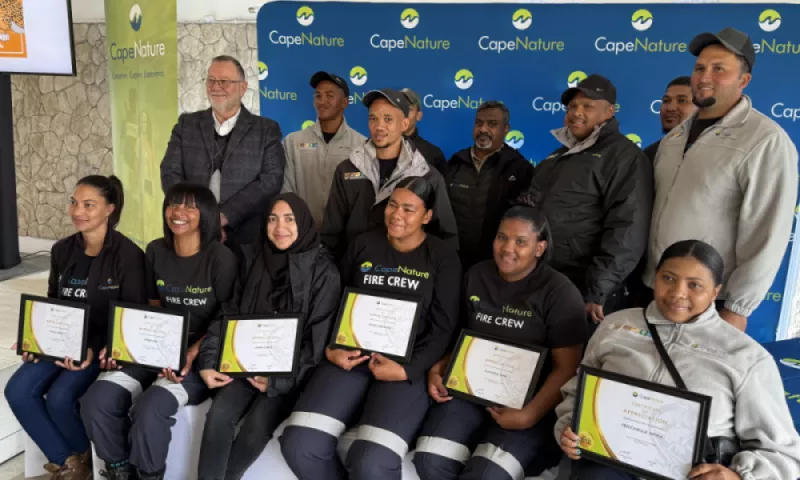
CapeNature has paid tribute to the firefighters and field rangers who risked their lives during one of the Western Cape's most challenging wildfire seasons.
An appreciation event was held in Velddrif on Tuesday, 4 August, recognising a representative group of firefighters and field rangers who served on the frontlines throughout the 2025/26 fire season.
Despite battling extreme heat, rugged terrain and unpredictable fire conditions, the teams worked tirelessly to protect communities, infrastructure and the province's unique biodiversity. Their efforts helped minimise damage to homes, public infrastructure and environmentally sensitive areas.
The event also marked International Firefighters' Day, observed annually on 4 May, and followed World Ranger Day on 31 July, highlighting the dual role many CapeNature field rangers play as firefighters.
CapeNature also acknowledged the vital support received from municipalities, the City of Cape Town, the Provincial Disaster Management Centre, Working on Fire, Fire Protection Associations, Volunteer Wildlife Services and private landowners who assisted throughout the wildfire season.
Western Cape Minister for Local Government, Environmental Affairs and Development Planning, Anton Bredell, praised the firefighters for their dedication.
"The reality is that firefighting is one of the most physically demanding occupations imaginable. Thank you for your professionalism, your courage and the sacrifices your families make alongside you. You represent the very best of the public service," Bredell said.
CapeNature CEO Dr Ashley Naidoo warned that wildfire activity continues to increase across the province.
"Our firefighters continue to go above and beyond to protect our communities, biodiversity and infrastructure, often under extremely difficult conditions. Our long-term analysis shows the number of fires is on a significant upward trend, with the average area burned per fire more than doubling over the past 20 years," Naidoo said.
The 2025/26 fire season began earlier than usual, with 35 fires recorded during spring before the Cederberg Wilderness Area experienced its largest wildfire since 1997. About 53,310 hectares burned, affecting roughly 75% of the reserve.
Two major fires in January later scorched another 33,719 hectares in the Paarl, Franschhoek and Jonkershoek areas, destroying the historic Chamonix Hotel National Monument. Between January and March alone, nearly 68,000 hectares were burned.
Over the entire season, CapeNature responded to 107 wildfire incidents that burned a combined 215,936 hectares. Nearly 76,650 hectares of the affected land fell within CapeNature-managed reserves.
CapeNature field ranger and firefighter Ethan le Fleur said conditions on the fireline could change in an instant.
"A fire that looked contained could suddenly shift with the wind and escalate quickly. You are exhausted, but you keep going because people are depending on you, your team, communities and the landscapes we protect," he said.
Firefighter Claudene Zimri added that while the work is physically and emotionally demanding, teamwork remains one of the greatest strengths during major wildfire operations.
"The physical and emotional demands are intense, but so is the motivation to keep protecting lives and the environment. What stands out is how different organisations work together. That support makes the hardest days manageable," she said.
An appreciation event was held in Velddrif on Tuesday, 4 August, recognising a representative group of firefighters and field rangers who served on the frontlines throughout the 2025/26 fire season.
Despite battling extreme heat, rugged terrain and unpredictable fire conditions, the teams worked tirelessly to protect communities, infrastructure and the province's unique biodiversity. Their efforts helped minimise damage to homes, public infrastructure and environmentally sensitive areas.
The event also marked International Firefighters' Day, observed annually on 4 May, and followed World Ranger Day on 31 July, highlighting the dual role many CapeNature field rangers play as firefighters.
CapeNature also acknowledged the vital support received from municipalities, the City of Cape Town, the Provincial Disaster Management Centre, Working on Fire, Fire Protection Associations, Volunteer Wildlife Services and private landowners who assisted throughout the wildfire season.
Western Cape Minister for Local Government, Environmental Affairs and Development Planning, Anton Bredell, praised the firefighters for their dedication.
"The reality is that firefighting is one of the most physically demanding occupations imaginable. Thank you for your professionalism, your courage and the sacrifices your families make alongside you. You represent the very best of the public service," Bredell said.
CapeNature CEO Dr Ashley Naidoo warned that wildfire activity continues to increase across the province.
"Our firefighters continue to go above and beyond to protect our communities, biodiversity and infrastructure, often under extremely difficult conditions. Our long-term analysis shows the number of fires is on a significant upward trend, with the average area burned per fire more than doubling over the past 20 years," Naidoo said.
The 2025/26 fire season began earlier than usual, with 35 fires recorded during spring before the Cederberg Wilderness Area experienced its largest wildfire since 1997. About 53,310 hectares burned, affecting roughly 75% of the reserve.
Two major fires in January later scorched another 33,719 hectares in the Paarl, Franschhoek and Jonkershoek areas, destroying the historic Chamonix Hotel National Monument. Between January and March alone, nearly 68,000 hectares were burned.
Over the entire season, CapeNature responded to 107 wildfire incidents that burned a combined 215,936 hectares. Nearly 76,650 hectares of the affected land fell within CapeNature-managed reserves.
CapeNature field ranger and firefighter Ethan le Fleur said conditions on the fireline could change in an instant.
"A fire that looked contained could suddenly shift with the wind and escalate quickly. You are exhausted, but you keep going because people are depending on you, your team, communities and the landscapes we protect," he said.
Firefighter Claudene Zimri added that while the work is physically and emotionally demanding, teamwork remains one of the greatest strengths during major wildfire operations.
"The physical and emotional demands are intense, but so is the motivation to keep protecting lives and the environment. What stands out is how different organisations work together. That support makes the hardest days manageable," she said.